Here at The Solar Lab, we review a lot of inverters. Most of them do at least something well, but they usually have at least a few drawbacks. And then there are the rare inverters that just make sense pretty much across the board.
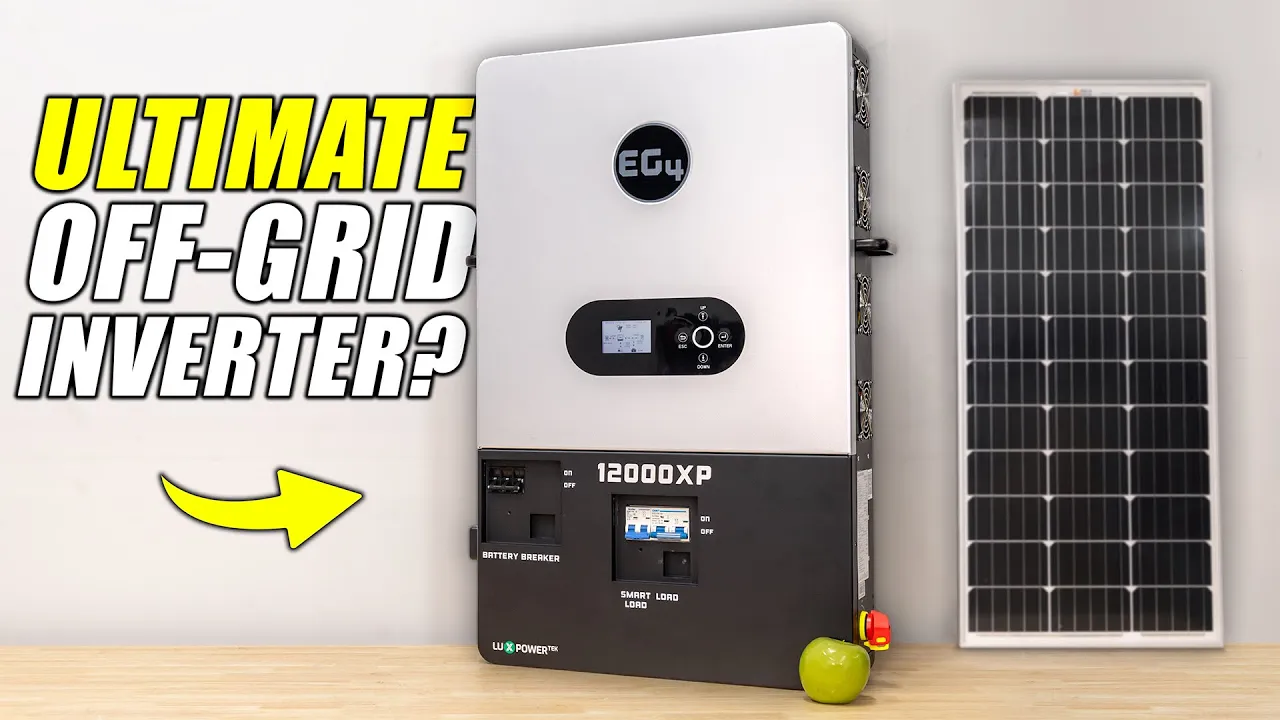
The EG4 12000XP Off-Grid Inverter V2 falls squarely into that category. Now, the 12000 XP isn’t the newest off grid inverter on the market, and it’s not trying to be the flashiest either. But when you consider how easy it is to use, the performance it delivers, and the very budget-friendly price, it continues to be one of the most practical choices for anyone building an off-grid solar system or backup power system in 2026.
This guide will explain why we continue to use and recommend it, even though it was released years ago. We’ll also explain why we think it’s one of the best options out there right now.
There’s a big difference between reviewing a piece of solar equipment and actually being able to rely on it. Throughout our shop, we have multiple solar and backup power setups that include various off-grid solar inverters and batteries.
Some of these systems are used to keep the lights on, charge our many portable power stations, and run various appliances. We also have full walls where we regularly rotate equipment in and out for testing purposes.
Over time, a pattern has emerged: whenever we need an inverter to test solar batteries or to film a how-to backup power tutorial, we tend to lean on the EG4 12000XP Inverter. The main reason for that is simply because we can always rely on it to just work as it should. That consistency says a lot more than any specifications sheet ever could.
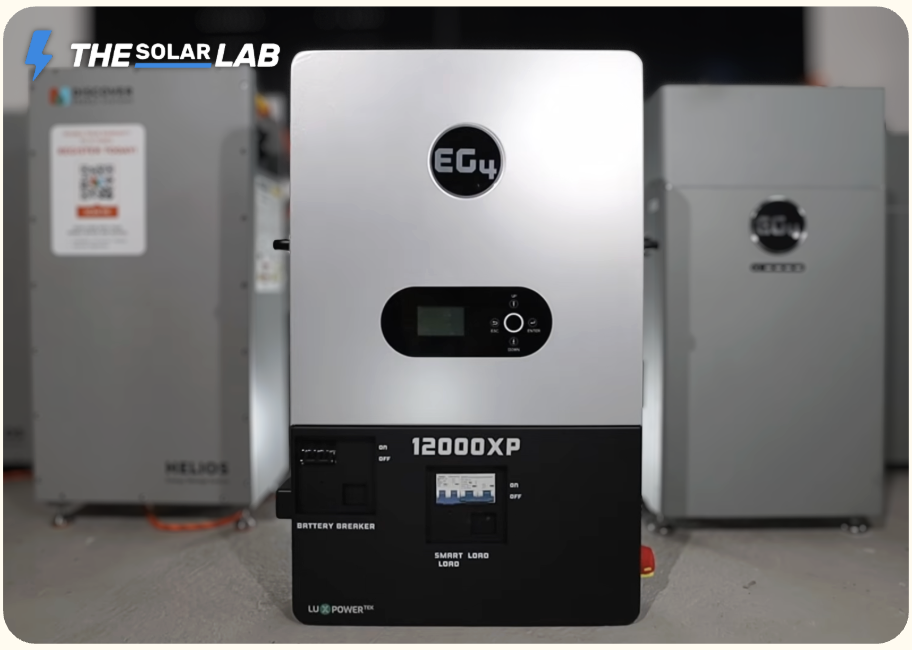
To be clear, this inverter is not perfect, and even our original review of the EG4 12000XP uncovered a few shortfalls. However, it is the simple fact that it does everything it should do relatively well that makes it such a compelling option for real-world setups. So, even though it’s not the best inverter for every single backup power setup and solar power system, we think it remains a great option for most people.
Again, one of the biggest reasons why this inverter continues to stand out is how well it balances power, practicality, and value. It’s powerful enough for serious applications, but not so oversized that it becomes complicated or unnecessary for the average person.
Here’s what you’re working with:
That combination places it right in what we’d consider to be the sweet spot for an off-grid solar inverter.
A 12,000W output gives you the ability to run a wide range of household appliances without constantly worrying about overloading the inverter. For most off-grid setups, that’s enough to comfortably power essentials like refrigerators, well pumps, lighting, power tools, and much more.
Personally, we use one full-time to run an EG4 Hybrid Solar Mini Split in our garage. Since we need to use the garage for year-round filming, this simple setup allows us to keep it warm during the winter and cool during the summer, all without increasing our utility bills.
It’s also worth noting that some of the more powerful hybrid systems, like the EG4 FlexBOSS18 Inverter, larger EG4 FlexBOSS21, and the Sol-Ark 15K, don’t dramatically exceed this output. That makes the 12000XP surprisingly competitive in terms of usable power, but at a fraction of the cost.
Where things really get interesting is the EG4 12000 XP’s 24,000W solar input. Realistically, most users will never fully max that out, and that’s what we like so much about it.
Instead of having to worry about hitting a ceiling and maxing out your solar input, you have the flexibility to expand your solar panel array over time. As you add more panels or grow your battery bank, the inverter is already capable of handling it.
In practical terms, if you got anywhere near that 24kW output with your solar panel array, you’d have the potential to charge 100kWh worth of solar batteries in just a few hours. That’s absurd!
And, although the average beginner probably won’t build a 24kW solar array, that kind of headroom is incredibly valuable if you want to build a scalable off-grid solar setup.
Investing in future-proof equipment is actually one of the main things we recommend to people who are looking at getting started with solar or backup power. Why risk wasting your money on something that you’ll only outgrow after a couple of years?
A common issue with high-capacity inverters is that they quickly become intimidating. More power usually means more complexity, and that can be a barrier for people who are just getting into off-grid solar systems.
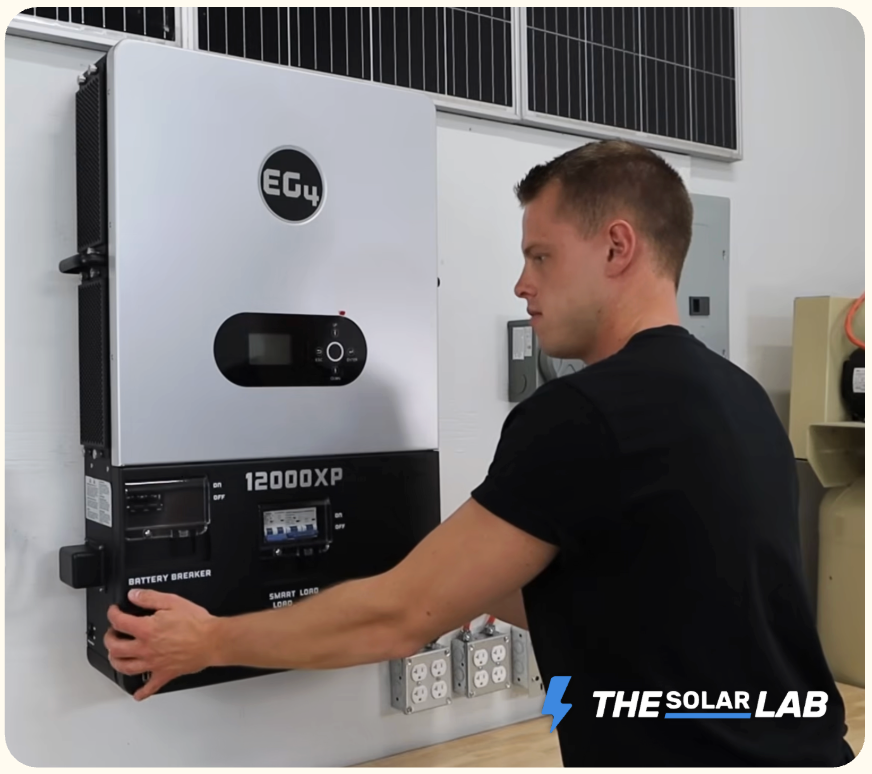
The EG4 12000XP manages to avoid that problem. Despite the high inputs and outputs, everything about it is designed to simplify the setup process.
For starters, it comes with a built-in display screen, which is something we’re starting to see a lot of inverters move away from in favor of app-based monitoring.
Plus, the display interface is really user-friendly, meaning the settings are easy to navigate, and you don’t need to rely heavily on external components or technical support just to get up and running. This makes it a strong option for beginners who want a powerful inverter for solar without dealing with an overwhelming learning curve, or having to hire someone to install it for you.
Sure, it weighs just over 100 lbs, so you may need a little help mounting it, but the actual setup process is very beginner-friendly. Even if you’re totally new to DIY solar, the 12000XP doesn’t feel intimidating.
Again, thanks to its huge input potential and reasonably high output, you’re also not going to outgrow it after a few months or years. Instead, it gives you a platform that can scale alongside your system, which is exactly what most people need when they’re building a backup power system or transitioning into full off-grid living.
If you do decide to expand your system, you also have the option to run it in parallel with up to 16 units for a ridiculously high total output of 192kW. Anything beyond that and you’re going way outside of a residential solar power system.
Performance and ease of use are important, but the real reason this unit continues to stand out in 2026 is the value it offers.
When we first reviewed the EG4 12000XP almost a year ago, it was priced closer to $2,400. Recently, we’ve seen it drop down to around $1,899, which completely changes the conversation. It's actually even cheaper if you use our discount code!
To put that into perspective, the EG4 6000XP All-in-One Inverter, a smaller and very popular entry-level option, sits around $1,600.
For roughly $200 more, the 12000XP delivers significantly more power and solar input while maintaining the same design and reliability. That makes it a much stronger long-term investment for most users. Honestly, we don’t get why anyone wouldn’t just spend the extra 200 bucks and future-proof their system.
When you start comparing it to larger systems, like the above-mentioned EG4 FlexBOSS 18 or Sol-Ark 15K Inverter, the value gap becomes even more obvious. If you consider that the Sol-Ark 18K costs around $6,700, you could instead:
Sure, those more expensive and more powerful inverters are designed for different applications, particularly grid-tied or hybrid setups, but if your focus is purely off-grid solar, the 12000XP delivers way more usable power per dollar.
You just get significantly more usable power for the same price. In fact, we wanted to put this guide together for the simple fact that comparing them directly almost feels unfair.
{{review-summary}}
Another area where this EG4 inverter stands out is in what it includes right out of the box.
There’s a noticeable trend in the industry toward stripping features out of the main unit and turning them into add-ons you need to purchase separately. That often means greater up-front costs, more wiring, and a more complicated installation process.
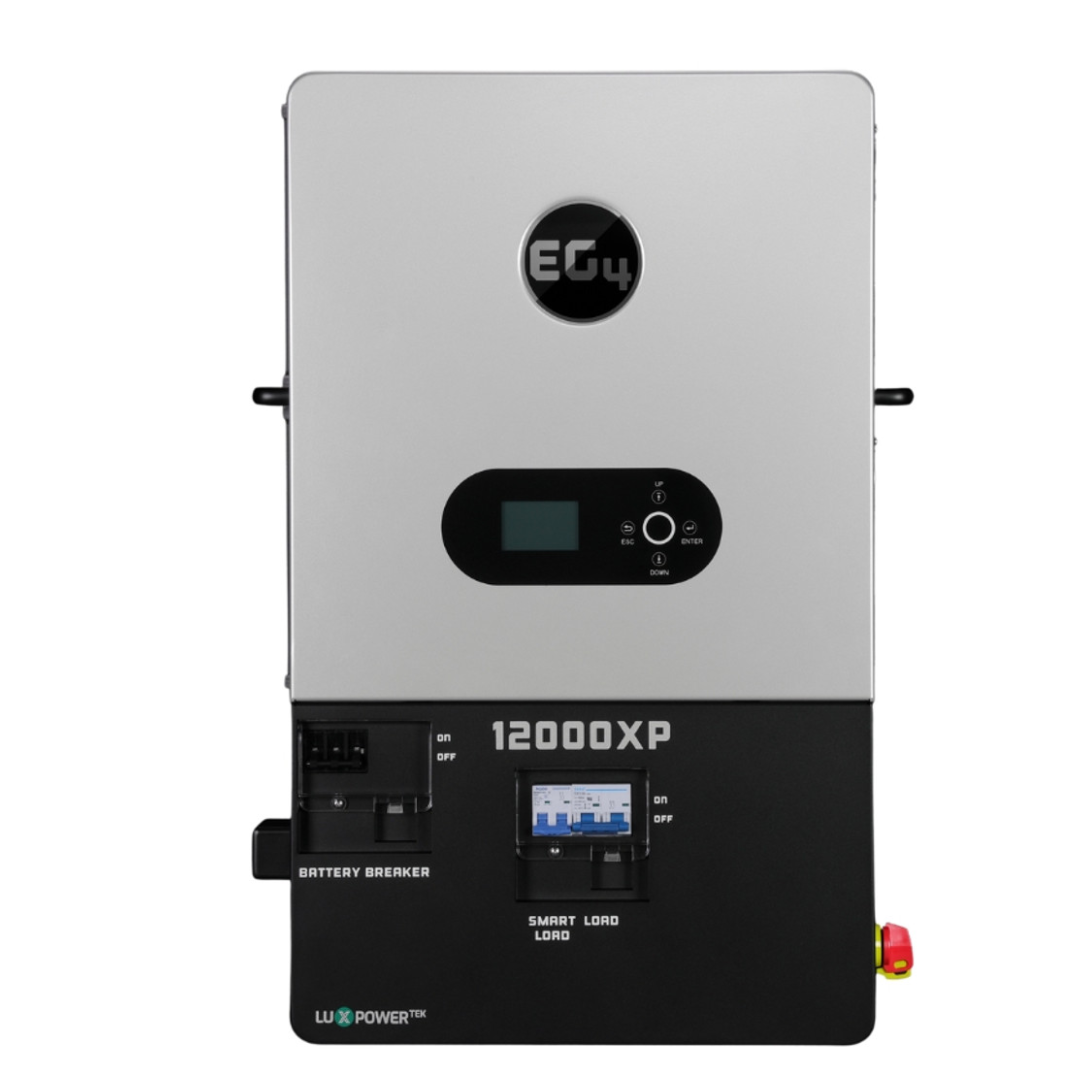
With the 12000XP, EG4 took the opposite approach. It includes a built-in display, integrated breakers, and a PV isolator, all within a single inverter. You save money and enjoy a more seamless installation process. It’s a win-win.
While everyone likes having the latest equipment, another advantage of choosing an inverter that has been on the market for a while is the simple fact that it has had time to prove itself.
We’ve used it repeatedly in different configurations, installed and uninstalled it multiple times, and run it under all kinds of different loads. As mentioned earlier, we also have a second unit that we use almost every single day to run our garage HVAC system.
Through all of that real-world use and testing, the 12000XP has remained a dependable inverter. It’s that kind of real-world reliability that we think can be more valuable than incremental improvements to the specifications.
It’s easy for a product to look good on paper, but it’s much harder for it to hold up over time in actual use. The EG4 12K XP has done exactly that for us.
This inverter makes the most sense for people who are building practical, scalable systems rather than over-complicated setups.
It’s particularly useful for those with remote cabins, tiny homes, garage workshops, and other basic off-grid power systems.
It’s also a really good option for phased builds where the system will be upgraded over time. When paired with the right solar panel setup and battery bank, it can serve as the backbone of a powerful and scalable backup power system.
While it doesn’t offer the grid interaction capabilities of hybrid systems like the EG4 FlexBOSS lineup, it excels in what it’s designed to do: deliver reliable, high-capacity power for off-grid solar applications.
The EG4 12000XP Off-Grid Inverter V2 continues to earn its place as one of the most beginner-friendly and budget-friendly off-grid solar inverters.
It combines strong performance, a user-friendly design, and affordable pricing in a way that very few competitors can match. More importantly, it’s a product we continue to use ourselves, which says more than any feature list ever could.
If you’re looking for a powerful, scalable, and practical inverter for solar, this remains one of the smartest choices you can make in 2026.
We test solar products so you don’t have to. Check out our opinions and which units we think are worth your money and which ones aren't.
More Reviews >