If you’ve been shopping for a serious solar inverter or you’re planning on building a full off-grid solar or hybrid setup, chances are you’ve come across the Sol-Ark brand.
They’ve built a reputation for premium hardware that performs really well, but they’re also known for charging premium prices. And the brand-new Sol-Ark 18K 2P LV Hybrid Inverter might be their most ambitious inverter yet. In fact, Sol-Ark markets it as the most powerful hybrid inverter money can buy!
We previously reviewed the Sol-Ark 15K Hybrid Inverter, and while we liked it, pricing has always been a sticking point with this brand. So naturally, the big question with the 18K is simple: is this hugely powerful inverter one of the best on the market, or is it overpriced? Let’s find out.
Before we dive into our testing, as well as all of the things we like and dislike about the Sol-Ark 18K, let’s take a look at what this beast offers on paper:
{{review-summary}}
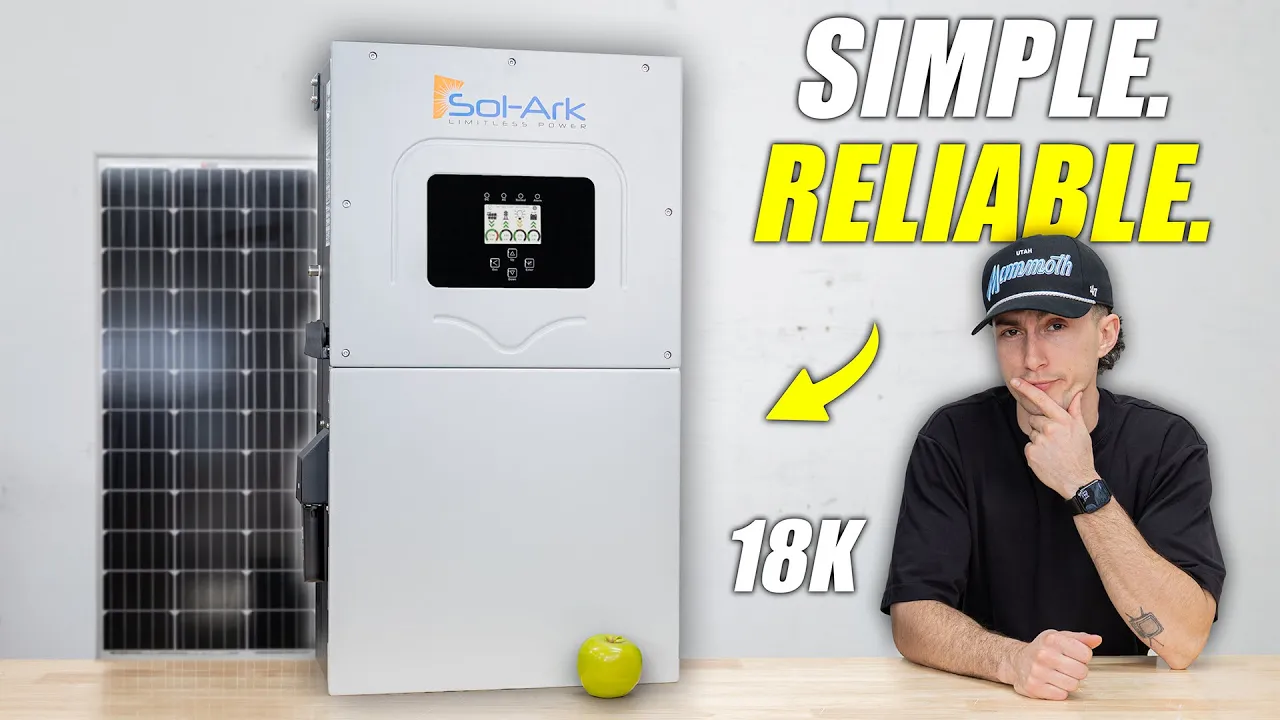
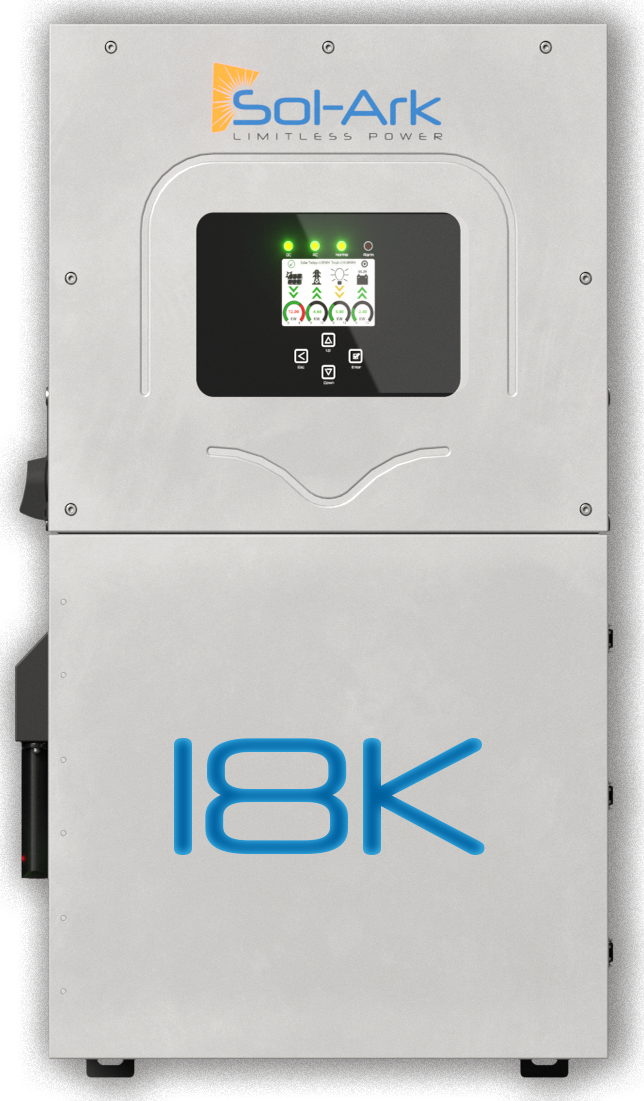
If you’ve seen any Sol-Ark inverter, the Sol-Ark 18K-2P will look familiar. They have stuck with the same build that we’ve seen used for all of their past releases. Same gray color scheme, side-mounted switches, and familiar industrial design.
You also get the same front-facing LCD display screen we’ve seen on other Sol-Ark inverters. The screen isn’t flashy, but it is functional. It gives you access to most of the settings and information you’d want, but there are some things you can only control through the app.
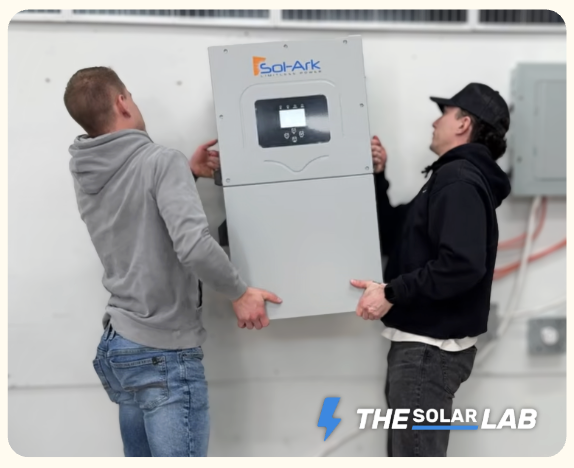
What has changed with this inverter is the scale. At just over 137 lbs, this thing is a beast. With that weight and bulk, it’s not exactly the most DIY-friendly inverter to mount on your own (even Tiny Baby struggled).
We doubt the weight is going to be a huge issue for a lot of their customers, as Sol-Ark tends to lean into providing components for professionally installed systems, but you could definitely install it yourself (if you had some help with the lifting).
In fact, we found it fairly straightforward to get it up and running, and that’s because Sol-Ark intentionally made installation easier in a few thoughtful ways.
Most of the internal lugs can be adjusted using the same tool, which sounds like a small detail, but anyone who’s installed an inverter knows how frustrating mismatched hardware can be. The sides also feature a built-in PV disconnect, a physical power switch, and a bunch of different ports for connectivity (including an oversized Wi-Fi dongle).
After we got it mounted and hooked up, we found it really impressive just how much functionality Sol-Ark packed into this thing. Behind the main panel door, you get multiple MPPTs, all of your battery connections, grid input and load outputs, generator inputs, and a bunch of smart control ports.
When you consider it’s also designed to supply power to the most demanding loads, including high-demand HVAC systems, while also supporting huge solar inputs, it’s clear Sol-Ark wanted this thing to be the go-to inverter for huge residential setups.
Now that you know what it’s supposed to do, let’s take a look at what we liked about it after we put it through all of our real-world testing:
It’s not the most surprising thing given the cost of this inverter, but it delivers in all of the areas that Sol-Ark advertised.

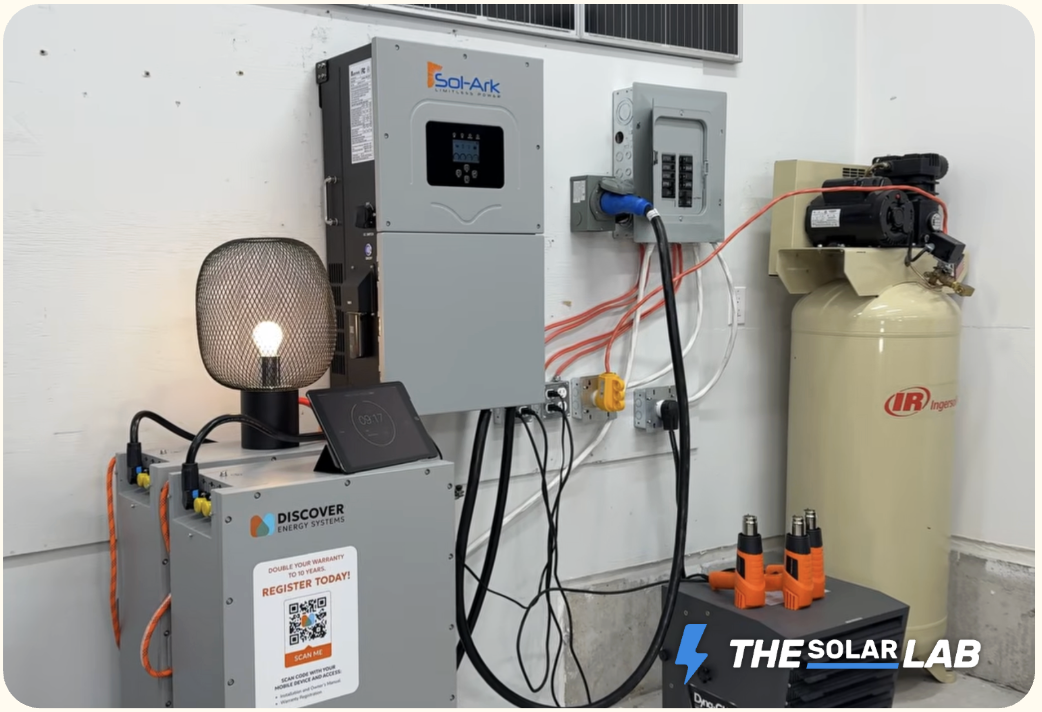
We were able to easily push it to its full 18kW continuous output rating. It also handled surges extremely well, allowing us to start up the huge compressor we keep out in the garage. That 36kW surge rating isn’t just marketing, it actually held up in our real-world testing, and that’s hugely impressive.
What this means for the average user is that you could comfortably use this inverter to start and run some of the heaviest loads without worrying about tripping the system. So, if you had something like a 5-ton air conditioner you wanted to run on battery power during an outage, the SolArk 18K would be a really good option.
The charging performance was equally impressive. We were able to push the full 18kW into our server rack battery setup, making this one of the fastest charging inverters we’ve ever tested. The 32kW solar charging also worked really well, making it the perfect option for those with high output solar panel arrays.
One of the biggest advantages of this Sol Ark inverter is how flexible it is. The gas generator input isn’t just a generator input, it can double as a smart load port. That means you can connect something like an EV charger or water heater and program it to turn off when battery levels drop below pre-set levels, or the demands on the inverter are getting too high.
With a lot of other hybrid inverters, smart features like that typically require additional hardware. For example, if you went with an equally powerful EG4 inverter setup, you’d need to pair your FlexBOSS Inverter with the GridBOSS MID to achieve the same smart load management functionality.
It’s worth noting that the EG4 FlexBOSS21 Hybrid Inverter and the EG4 GridBOSS MID together would still cost less than the Sol-Ark 18k, but having everything built into one unit is really handy for those with limited space.
Plus, Sol-Ark’s hybrid inverter has a bunch of different operating modes out of the box, including grid-tied and grid sell-back, hybrid mode, off-grid mode, and peak shaving features. This makes it suitable for everything from dedicated backup power systems to fully grid-tied systems.
Another standout feature is the inclusion of three MPPT inputs. Even the best solar inverters usually come equipped with two, but Sol-Ark packs three, which gives you more flexibility when designing your solar array.
If you have panels facing different directions, set up on different roof or ground mounts, or you’re dealing with partial shading on part of your array, you can optimize each string of panels independently instead of compromising overall performance. For larger and more complex residential solar power systems, this flexibility can be a big advantage.
Customer support has always been an area where Sol-Ark stands out. They offer a centralized knowledge hub with all of your documentation, guides, and setup instructions, which makes installation and troubleshooting much easier.
In our own experience, their support team is responsive, knowledgeable, and genuinely enthusiastic when it comes to helping solve problems, even when they’re really complicated. When you’re spending over $6,000 on a solar inverter, that level of support really matters.
Despite its size and power, the Sol-Ark 18K is surprisingly quiet. That might not seem like a big deal, but if your inverter is installed inside your garage, basement, or near any living space, it’s a noticeable quality-of-life improvement. Trust us, you don’t want to hear a noisy inverter humming away while you’re trying to sleep.
Sol-Ark labeled this thing a “premium” hybrid inverter, and having a unit this powerful run this quietly is one of the areas where we think it earns that badge.
While there was a lot to like about this hugely powerful inverter, it’s not without its faults. Here are a few of the things we wish were just a little bit better:
For such a premium product with a premium price tag, the app is pretty underwhelming. Don’t get us wrong, it does work, allowing you to monitor and control most things, but it feels clunky and definitely isn’t intuitive. Even just navigating the settings is far from straightforward, and key controls are buried in menus that aren’t immediately obvious.
With that said, by far the biggest issue is the lack of real-time monitoring. The inverter only updates data every five minutes, and you even have to manually refresh to see changes! That makes it difficult and frustrating to actively monitor system performance.
We brought this up to Sol-Ark, and they did acknowledge our frustrations and claim that a new app is on the way, but as it stands today, this is a weak point.
While the somewhat frustrating app experience left us feeling a bit disappointing, what annoyed us the most was the lack of compatibility with most of the solar batteries we tried to connect it to.
Turns out, the Sol-Ark 18K only works with a small list of approved battery brands, including:
You might be thinking a simple workaround would just be to buy your batteries from one of those brands, but that doesn’t help people who already have an existing battery bank. Plus, we’ve tested a lot of batteries, and we haven’t had great experiences with any of those brands.
Meanwhile, some of the best-value batteries on the market, including the EG4 WallMount series and hugely popular EG4 LL-S 48V Battery, aren’t supported. Given EG4 is Sol-Ark’s main competitor in the inverter space, lack of compatibility with EG4 batteries feels more like a strategic decision than a technical error.
Whatever the reason, this issue restricts your options and it would make designing your system more difficult than it needs to be.
We measured the idle draw to sit around 108W, which means this inverter does consume a fair amount of power just being left on.
To be fair to the 18K, it’s a very large, high-capacity inverter, so the idle draw definitely isn’t unreasonable. Still, it’s something to keep in mind, especially for fully off-grid solar power setups where every watt matters.
There’s no way around it, this is a really expensive inverter. At over $6,000, it’s significantly more expensive than pretty much anything else on the market right now, including alternatives from EG4 that can be built to match the 18K’s input and output ratings.
And while the Sol-Ark 18K performs extremely well, it’s tough to argue that it offers anywhere near the best value. If you just want something that’s really high performance and price isn’t an issue, it could be the right option, but you’d have to accept that you’d be spending more than you needed to.
The Sol-Ark 18K Hybrid Inverter is undeniably a high-performance piece of equipment, even if it’s not the best fit for everyone.
It delivers excellent output, handles large loads with ease, and offers a level of integration and support that’s hard to beat. If an installer recommends it and you’re comfortable with the price, it’s a solid choice.
There’s no getting around the fact that there are much more affordable alternatives out there that can deliver close to the same performance. However, if Sol-Ark improves the app experience and opens up battery compatibility in the future, it could still become one of the most interesting hybrid inverters on the market.
We test solar products so you don’t have to. Check out our opinions and which units we think are worth your money and which ones aren't.
More Reviews >