When EG4 first released the original Chargeverter a couple of years ago, it quickly became one of those behind-the-scenes tools that we use here at The Solar Lab on a regular basis. It wasn’t flashy, but that’s because it was just designed to solve a very specific problem: protecting batteries when they’re being charged with the dirty power that gas generators output.
Now that EG4 has launched an updated Chargeverter Plus, the big questions aren’t whether it’s useful and actually works, it’s if EG4 has actually improved the design to deserve our recommendation, or if they just relaunched a product that was already pretty complete.
To find out, we put the EG4 Chargeverter Plus through all of our usual real-world testing. We’ll explain what it’s supposed to do, what we like and dislike about it, and whether or not we think you should purchase one for your solar or backup power system.
Before we get into its real-world performance, here’s a quick look at what the Chargeverter Plus looks like on paper:
{{review-summary}}
Just like the original EG4 Chargeverter we reviewed, the new Chargeverter Plus was designed to take the unstable and inconsistent power that gas generators output and convert it into clean, stable electricity that you can use to safely charge your batteries.
That may sound like a niche issue, but it addresses a major problem that a lot of people face when running solar power systems and high-capacity power stations, like the EcoFlow DELTA Pro Ultra or Bluetti Apex 300.

Basically, gas generators produce power with far less consistency than the “clean” power you pull from the grid, especially if you are pushing your generator to its limits. Some gas generators have built-in inverters, but even still, the power they output can fluctuate, which puts stress on batteries or power stations that you are charging with that power.
Signature Solar is one of EG4’s main distributors, and they’ve told us that one of the leading causes of equipment failure they see is the overuse of this type of “dirty” input power.
Instead of oversizing your generator to avoid the problem of running it at full capacity to charge your batteries or portable power station, the Chargeverter Plus is designed to act as a buffer. It cleans and regulates the incoming power before it reaches your system, helping to extend the lifespan of your equipment.
It’s also more flexible than you might expect. While it’s built with gas generators in mind, it can also be used with grid power, EV chargers, or any AC source you want to safely convert into battery charging.
In other words, it can act as an extra layer of protection in your system. You may not always need it, but when you’re charging a battery bank that is worth tens of thousands of dollars, the peace of mind alone can be worth it.
Just looking at it, the Chargeverter Plus doesn’t seem dramatically different from the original EG4 Chargeverter, but the improvements become noticeable once you start paying attention to the details.
The upgraded IP54 rating is one of the most important changes. While it’s not designed to sit out in the rain for extended periods, it’s now far more capable of handling dust and light exposure to moisture.
That makes it much better suited for garages, sheds, tiny homes, and other places where it may be partially exposed to the elements. Given its primary purpose is to work alongside gas generators, making it more capable of being outdoors makes a lot of sense.
We also think the improved weather rating would make it a useful addition to an EG4 BOSSBox ESS setup. Even though the BOSSBox itself would provide some coverage, the original Chargeverter probably wouldn’t last too long inside that battery enclosure.
Another standout improvement is the operating temperature range. This unit is rated to function down to -40°C, which is a huge upgrade and particularly useful for those planning to use a gas generator in a colder climate. If your equipment lives in an unheated space, like an uninsulated garage, that added weather resistance matters.
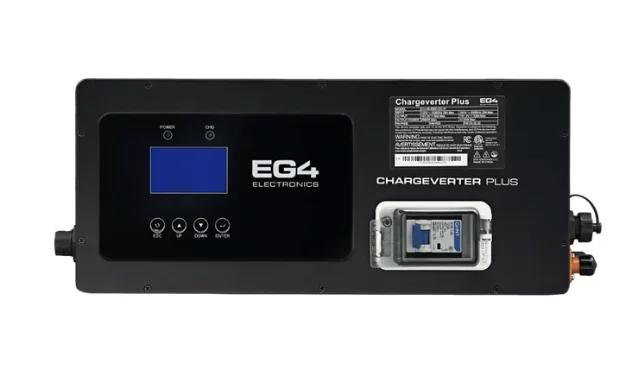
Outside of that, the layout is clean and functional. You’ve got clearly defined battery terminals, communication ports, and dry contacts for generator control. Those dry contacts allow the Chargeverter Plus to automatically start and stop a connected generator based on battery levels, which adds a layer of automation that can make backup power systems significantly more convenient.
It has the same display screen as the original, so no real changes there. However, it has improved closed-loop communication capabilities, meaning it can communicate with the battery management system (BMS) inside your batteries for improved charging.
In testing, the Chargeverter Plus did exactly what EG4 said it would do. The charging was consistent and stable, delivering between 92 and 95 amps depending on the setup we were testing.
When connected to a 240V source, it pushed over the 5,000 watts it’s rated for into our batteries. That’s enough power to recharge a typical 5kWh server rack battery, like the EG4 LL Battery or WattCycle 48V Battery, in about an hour.
The idle consumption was impressively low at right around 4 watts per hour. This means it doesn’t waste much energy when it’s running, so more of the power your generator produces ends up in your batteries.

One of the biggest advantages here is how the Plus version can change your approach to sizing a gas generator. Instead of needing to buy a high-output gas generator that exceeds the maximum input of your batteries to avoid stressing the generator and producing dirtier power, you can use a smaller unit and run it at full capacity. Oversizing the generator was a workaround for avoiding dirty power, but the Chargeverter Plus helps you avoid that.
Since the Chargeverter Plus handles the cleanup, ensuring that the power going into your batteries remains safe and stable, you can use a small gas generator to charge your batteries or power station. That can translate into real cost savings, which can be used to cover the full costs of the Chargeverter Plus itself.
The automatic generator control was another thing that worked perfectly during our testing. With the dry contact connections, we were able to set up our system so that when the batteries dropped below a certain level, the generator automatically kicked on, charged them back up, and then shut off automatically.
In other words, it turned a basic gas generator into a smart generator. For off-grid systems or backup setups, that kind of automation is incredibly useful.
Now that we’ve explained what it’s supposed to do, as well our own experiences using it, let’s get into all of the things we really liked about this improved version of the EG4 Chargeverter Battery Charger:
As we just outlined, the Chargeverter Plus delivered exactly what it promised. Charging is stable, efficient, and consistent, with the real-world performance closely matching the advertised specifications.
Doing what it’s supposed to do may sound like faint praise, but it’s exactly the kind of reliability you want from a product that was designed to protect the expensive equipment that makes up the rest of your system.
One of the biggest advantages of this unit is that it allows you to run a smaller generator at full capacity instead of buying a more powerful gas generator that you don’t actually need.
That not only saves money upfront, it also means you’ll burn less fuel while you’re charging your batteries. For those who just want to charge a power station with a cheap generator, the Chargeverter Plus could be the perfect accessory.
The inclusion of dry contacts for generator control adds a level of automation that makes a big difference in everyday use. Being able to automatically start and stop your generator based on battery levels simplifies backup power management significantly.
At around 4 watts per hour when idling, the Chargeverter Plus is very efficient. That’s an important detail for something that’s probably going to be used during blackouts, lengthy power outages, and emergency situations.
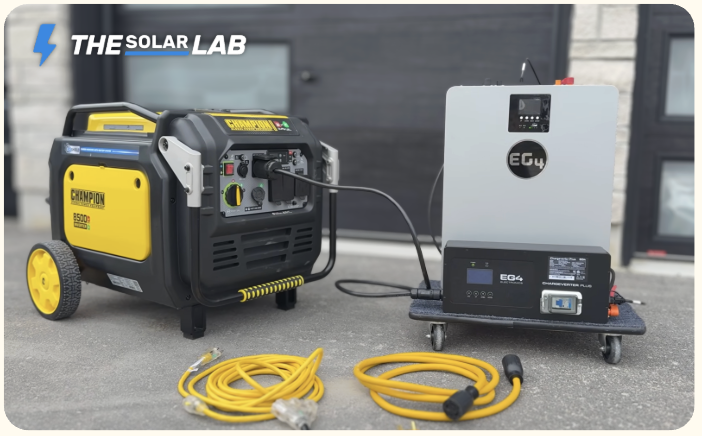
Realistically, most people with high-capacity backup power systems are going to rely on grid and solar power to charge their batteries on a day-to-day basis. If the grid is down and weather conditions are preventing you from charging your batteries that way, the Chargeverter Plus enables you to pull out a gas generator and use it both safely and efficiently.
The upgraded IP54 rating and extended operating temperature range make this unit far more practical for real-world installs than the original. Given that The Solar Lab is located in a cold climate, it’s something that we think we’ll really grow to appreciate, especially during the ice storm-related power outages that we’ve been dealing with the past few years.
While the performance was really impressive, and we appreciate most of the upgrades EG4 made, there are a few things we would change about it:
We really thought that app connectivity would be one of the first things EG4 would have added to the Plus version of their Chargeverter.
EG4 already has some very user-friendly apps for their inverters and battery systems, so it seems like it would have been a simple upgrade. Not being able to monitor and control the Chargeverter Plus alongside the rest of our solar or backup power system just seems like a missed opportunity.
The included cables are a bit too short for most real-world setups. Since you’re going to be using an outdoor gas generator to charge indoor batteries, you’ll probably have to buy some sort of extension cable to make everything work smoothly.
There are definitely workarounds, but the longest cable they include is only 7 feet long. Again, it just seems like an oversight.
Like we found with the original Chargeverter, the cooling fans on the sides of this unit can get pretty loud.
It’s probably not going to matter for most people, as pretty much any gas generator is louder, but it could be a bit annoying if you’re running grid power or an EV charger through the Chargeverter Plus.
The display screen interface does its job, but it’s also pretty minimal. You only get a few buttons, and navigating through the menus can feel a bit tedious.
We get why EG4 just re-used the screen from the previous version, but it would have been nice if they improved the display, or even just added a couple of extra buttons to make it easier to navigate.
When operating on 120V, the unit can draw more power than a standard household outlet is designed for. Without adjusting the settings, you could trip breakers, so it’s something you need to be mindful of during setup.
The EG4 Chargeverter Plus doesn’t try to reinvent anything, it just refines what they did with the original. It builds on an already solid product and makes it more durable, flexible, and better suited for real-world conditions.
If you already own the original Chargeverter, we wouldn’t go out and upgrade to the Plus version. If you don’t own a gas generator, and never plan to use one, it’s also unnecessary.
However, if you’re someone who relies on a gas generator to charge your solar batteries or power station on a regular basis, we think it’s a worthwhile investment that could easily justify its cost.
It’s not the most exciting piece of equipment you’ll ever add to your setup, but it might be one of the most practical. And when it comes to protecting an expensive battery system, that’s exactly what you want.
We test solar products so you don’t have to. Check out our opinions and which units we think are worth your money and which ones aren't.
More Reviews >