The Bluetti Pioneer Na 1500 Portable Power Station is one of the most genuinely interesting releases we’ve seen in a long time. This isn’t because it has a bigger battery or more powerful inverter, but because it’s fundamentally different.
This is the first Bluetti power station we’ve tested that uses a sodium-ion battery instead of lithium, and that single design choice changes who this power station is really for. Bluetti markets the Pioneer Na as a true cold-weather solution. Since the battery contains sodium (yes, salt), it’s able to charge at temperatures down to -15°C (5°F) and discharge down to -25°C (-13°F).
Those extreme temperatures are way below what any lithium-based Bluetti solar generators or competing portable power stations can safely handle. For anyone living in Canada, the northern U.S., or anywhere with long, cold winters, that alone makes this unit worth a closer look.
But new battery chemistry always comes with trade-offs. So, the real question is: does this new Bluetti Pioneer Sodium-Ion Power Station actually perform well enough in the real world to justify some of its issues? Let’s find out.
Before we get into testing, as well as our likes and dislikes, here’s a quick overview of what the Bluetti Pioneer 1500 Sodium-Ion Power Station is supposed to deliver:
{{review-summary}}
Most people don’t know anything about battery chemistries, so it’s worth taking a moment to quickly explain what is unique about this unit. The truth is, sodium-ion batteries aren’t new technology, but they’re only just starting to mature enough for consumer products, like portable power stations.
The biggest benefit with these types of salt-based batteries is their superior cold-weather performance. Where most lithium power stations simply refuse to charge below 0°C, or shut themselves down entirely, a sodium-ion battery keeps working.
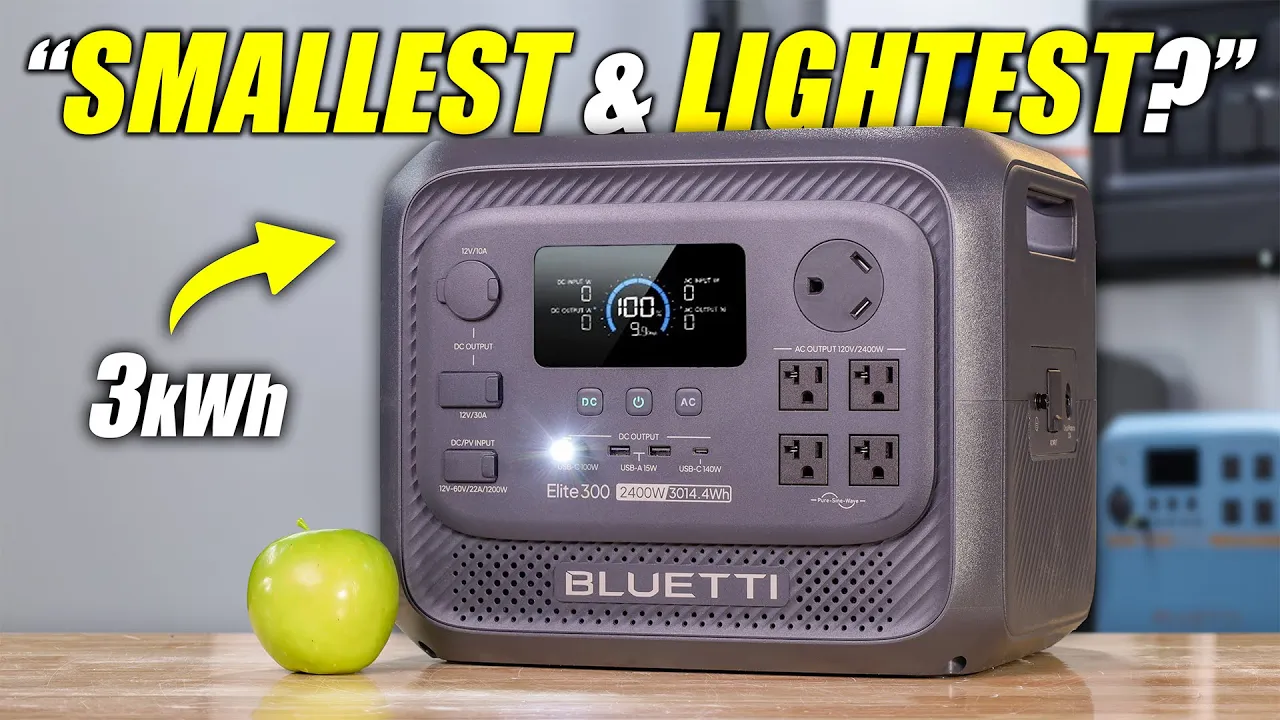
The trade-off is energy density. Sodium batteries are physically larger for the same amount of stored energy. To put that into perspective, you can compare this new Bluetti Pioneer Na to the Bluetti Elite 100 V2, which was released earlier last year
The Pioneer Na has a 900Wh battery, while the Bluetti 100 V2 packs 1,024Wh into a noticeably smaller body thanks to its LiFePO₄ battery. The sodium unit is bulkier, heavier, and offers less total capacity, but if this chemistry performs as advertised, that size trade-off is very reasonable for the right type of user.
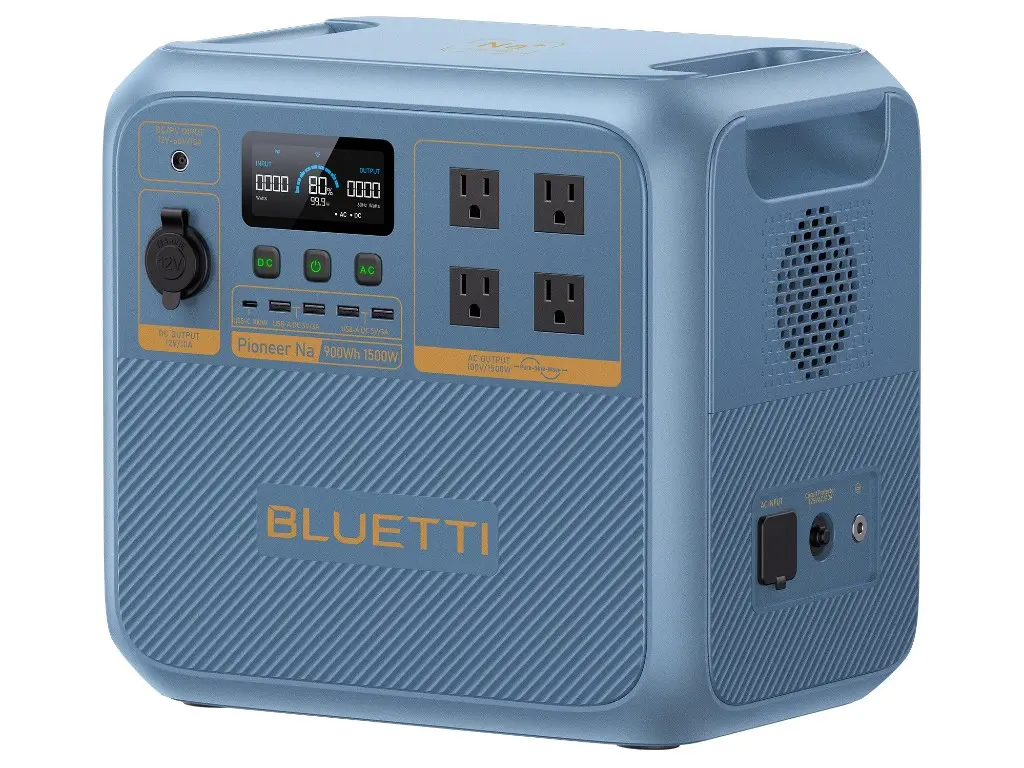
Visually, the Bluetti Pioneer Na 1500 looks a lot like what you’d expect from Bluetti. It introduces a new blue color scheme, but follows the Bluetti signature design style.
You get forward-facing outputs and a very functional layout. The only port that isn’t on the front of the unit is the AC charging port, which we really like, as it means you can still access everything if you have it shoved up against a wall, or in the trunk of a vehicle.
The port selection is solid, though not perfect. You get four AC outlets, a 12V car socket, a barrel connector, one USB-C, and four USB-A ports.
The inclusion of wireless charging on top is a welcome surprise, especially since many brands quietly dropped that feature over the last year. Personally, we find these wireless chargers incredibly convenient for topping up phones when you don’t feel like digging for the right cable.
The screen is clear, readable, and straightforward. The app also works well, even if it’s not the fastest app on the market. Still, it’s useful for monitoring performance and toggling outputs.
From a pure usability standpoint, this feels like a mature, well-thought-out Bluetti portable power station.
In our testing, the Bluetti Pioneer Na actually performed really well. When we tested the battery efficiency, it came in at 86%, which is solid for a portable power station in this class. We typically give any power station with an efficiency rating over 80% a thumbs up.
From empty to full, AC charging took about 1 hour and 3 minutes, which is genuinely pretty impressive for a 900Wh unit. The surge test passed without issue, and the UPS function worked as expected.
Noise levels were typical for a power station of this size. The fans sound like computer fans — audible, but not obnoxious. If you need whisper-quiet performance, you may want to look at something like a DJI Power 1000, but the Bluetti Pioneer shouldn’t bother you too much.
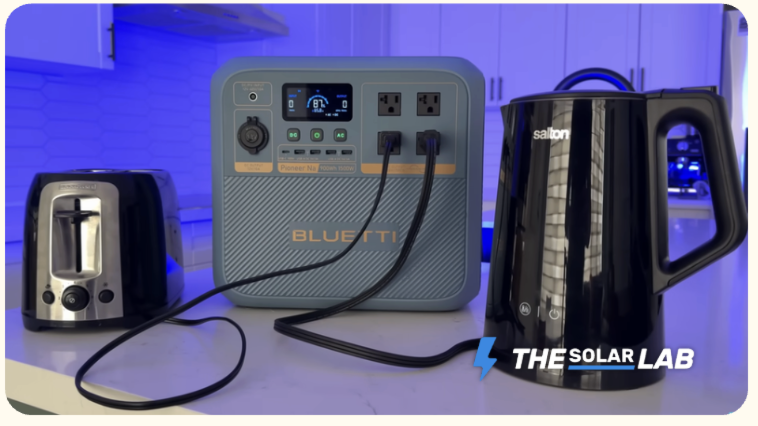
One of the biggest surprises we found during our real-world testing was the idle consumption. Bluetti advertises about 9W of idle draw with the AC inverter on, which is pretty low, but our testing actually showed an 8.6W idle rate.
That’s better than advertised, and refreshingly honest. At that idle rate, the Pioneer Na can sit powered on for about 4.5 days doing nothing, which is excellent for sump pumps, networking gear, or emergency readiness.
Now that we’ve covered the results of our testing, let’s take a look at all of the things we really liked about this innovative power station:
This is where the Pioneer Na truly separates itself from nearly every other portable power station we’ve tested.
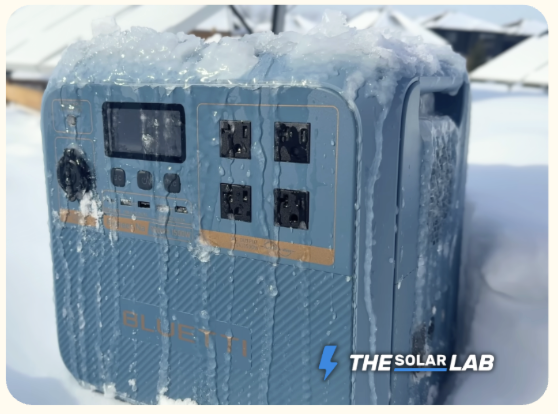
In real-world testing, the cold-weather claims actually held up. The unit charged and discharged down to its rated temperatures without refusing to work. Bluetti does throttle charging and discharging power by about one-third at extreme temperatures, but that’s a fair compromise. The key point is that it still works, even in some pretty extreme temperatures.
For most people, the biggest benefit isn’t ice fishing or winter camping. It’s peace of mind. You can leave this power station in a garage, shed, cabin, or vehicle and know that when you pull it out, it will actually turn on. That’s something lithium power stations routinely fail at in winter.
This alone makes the Bluetti Pioneer Sodium-Ion Power Station one of the most practical cold-climate power stations available right now.
All of the outputs on the Bluetti Pioneer Power Station are forward-facing, which makes using it in tight spaces (like a vehicle, cabin shelf, or garage) much easier.
The inclusion of a wireless charging pad on top is also a welcome bonus, especially since it’s something most power station brands have dropped in recent years. Even the rubberized feet on the bottom help the unit grip surfaces, giving it a much more solid feel.
In real-world testing, the Bluetti Pioneer Sodium Ion achieved about 86% efficiency and wall charged from empty to full in just over an hour. The idle power draw with the inverter on was a very respectable 8.6W, meaning it could keep intermittent loads, like a refrigerator, running for days.
Most of the unit’s other features, including the UPS function, input and output ports, and the fans all worked as advertised. The unit was also surprisingly quiet under typical loads. It’s just an all-around solid performer.
While it impressed us in a lot of ways, no power station is perfect, and the Pioneer Na is no exception:
Bluetti claims the Pioneer Na can survive a 1.2-meter drop (about 4 feet).

We wanted to test this for ourselves, so we intentionally knocked it off the tailgate of our truck. Just dropping it from this height (about 1 meter, or 3.3 feet) caused visible damage.
While nothing essential broke, plastic clips and some of the outer facing popped off. The unit also took a lot of visible damage. It’s also worth noting that we ran this drop test when the unit had just been inside, so the plastic was roughly at room temperature. Had we tried it while it was cold, it’s likely that a lot of those plastic components would have shattered.
When you compare it to much more rugged competitors, like the incredibly durable Jackery Explorer 1500 Ultra, it seems like Bluetti exaggerated how tough this thing is. Not only does that Jackery power station have sealed port covers for outdoor use, it survived a similar drop test with only a few surface scratches.
Bluetti advertises this unit as the ideal companion for ice fishing and outdoor winter work, but taking the unit outside into snow or moisture led to an icy buildup in the cooling fans and around the plugs.
In one case, condensation buildup after returning to a warm indoor environment caused the unit to shut itself off for protection, requiring roughly 24 hours before it could be used again. Bluetti even confirmed this issue when we reached out to them. That’s counterintuitive for a product touted as suitable for serious winter use.
In 2026, having four USB-A ports and only one USB-C port feels pretty old-school. Most modern devices prefer USB-C, and requiring adapters undermines efficiency and convenience.
If you have multiple devices that charge via a USB-C input, you’re going to need to plug in an adapter and use a 120V AC port. Since this means you’ll also be using the unit’s inverter to convert DC power to AC power, then back to DC, it kind of defeats the efficiency benefits of DC power.
The Bluetti Pioneer Na’s single 500W solar input is a bit undersized, but our main issue with it is that it uses a single port. This means you must use adapters to connect multiple solar panels.
Most competitors offer multiple solar ports, making it easier to connect multiple folding solar panels when you’re camping or just trying to plug the unit into a non-permanent solar panel setup.
At the end of the day, the Bluetti Pioneer Na 1500 Portable Power Station fills a very specific niche, and we think it fills it well.
If you live in a cold climate and want a portable power station that won’t become a brick when temperatures drop, this is one of the best entry-level options available. It’s reliable, efficient, reasonably priced, and genuinely different from the sea of lithium-based solar generators on the market.
It’s not perfect. The durability claims are questionable at best, moisture management could be better, and the USB selection feels slightly behind the times. But for cold-weather users, those downsides are outweighed by the simple fact that this power station actually works when others don’t.
If Bluetti ever combines this sodium-ion battery chemistry with improved weather sealing and a more modern port layout, they’ll be very close to building a perfect cold-climate portable power station.
With that said, if you don’t need cold-weather performance, we’d recommend choosing something like the Bluetti Elite 100 V2, or even the budget-friendly Pecron E1000LFP, which has comparable specifications at a significantly lower price point.
We test solar products so you don’t have to. Check out our opinions and which units we think are worth your money and which ones aren't.
More Reviews >