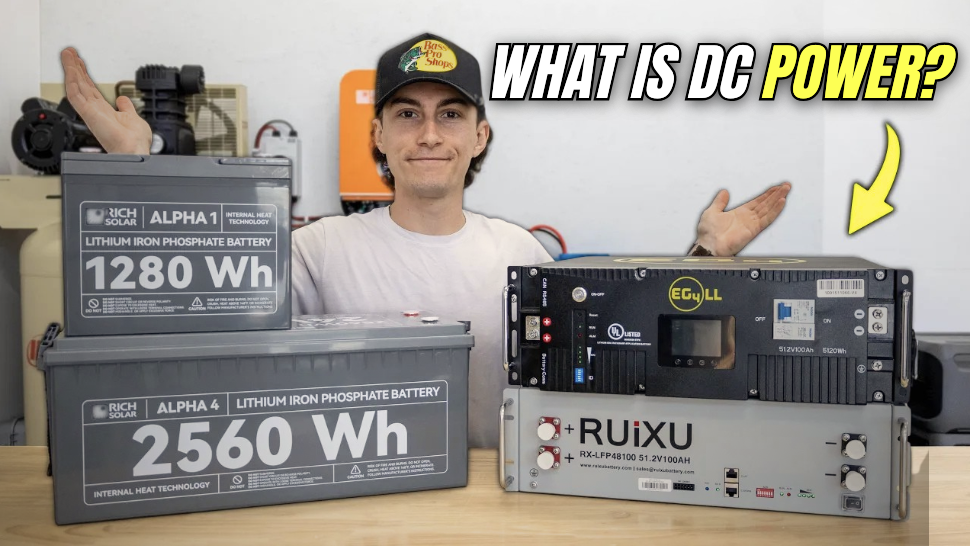
If you’re just getting into solar, you have probably seen the term direct current (DC) getting thrown around quite a bit, especially in reference to batteries, panels, and other solar components. But what does DC power mean, and why does it matter?
Imagine electricity is like cars driving on a road, now think of direct current like the type of traffic where all the cars (electrons) are moving in the same direction at the same speed. Everything is nice and orderly, which is how you should think of DC power.
The opposite of that would be alternating current (AC), where the cars (electrons) keep switching directions and changing lanes like a bunch of indecisive and impatient rush hour drivers.
Still confused? Don’t worry, that wasn’t the best analogy, but the fundamentals of direct current are pretty easy to understand. Not only will this guide explain what DC power is and why it’s important when you’re talking about solar power systems, we’ll also provide a quick alternating current vs direct current comparison, so you can understand the difference.
Direct current, or DC power, is a type of electricity where the flow of electrons moves in one continuous direction. It’s steady, predictable, and perfect for things like batteries, rechargeable electronics, and it’s the type of power that is produced by your solar panels.
Picture the battery inside a flashlight: when you turn it on, the electricity flows from the positive terminal to the negative terminal in a steady, one-way stream. That’s DC power in action.
The same principle applies to solar panels. When solar panels generate electricity, they produce DC power, which is then converted into AC by your solar power system’s power inverter.
This DC to AC inversion process carried out by your power inverter is done in order to supply usable electricity to your home (because our electrical grid runs on AC, so most of our appliances and devices run on AC power).
But why do we even need two types of electricity? Let’s find out.
Picture a game of tug-of-war, except instead of pulling one way, both teams keep switching directions either 50 or 60 times per second (60 times in the U.S.). That’s what alternating current (AC) looks like.
Again, this is the kind of back and forth, wave-like electricity is what powers most of the things in your home. If you plug something into a wall outlet, it’s going to be pulling AC power. It’s great for long-distance transmission, which is why power grids and transformers use it.
Now, picture direct current (DC) more like a one-way sprint. The electrons don’t switch directions. Instead, they just keep flowing in the same way, making it ideal for electronics and batteries that require stable and consistent power.
If you’re feeling confused, here’s a simple breakdown:
It’s a bit of a sidetrack, but this whole AC vs. DC debate actually goes way back to the late 1800s with the infamous War of Currents between Thomas Edison (team DC) and Nikola Tesla (team AC).
Spoiler alert: Tesla’s AC power won for powering homes and cities, but DC is still very much alive and kicking in the modern world, especially as the portable batteries inside our smartphones and other portable devices become increasingly important.
The answer to why solar power is DC is actually pretty simple: solar panels generate direct current DC.
When sunlight hits the glass surface of a solar panel, it is absorbed into the solar cells. That absorbed sunlight then excites electrons inside the solar cells beneath the glass face of the solar panel. This creates a one-way flow of electricity, making DC power the natural format for the solar electricity your solar panels generate.
Your solar batteries then store the DC power your solar panels generate. Even portable power stations store DC power inside their built-in batteries.
Basically, pretty much everything in the solar power world starts as DC power before being converted into AC power by a power inverter. Again, this is done so the power can be used by appliances and tools that are running off that stored solar power.
Plus, if you have a grid-tied solar system that sells power back into the grid, the inverter needs to convert that DC power to AC power in order for the grid to be able to accept it.
We already discussed why most appliances require AC power, and that is simply because AC power is easier to move across long distances, so it’s favored by the grid. But, with the rise in solar power, especially for off-grid purposes, we are starting to see a bit of a DC comeback.
For off-grid cabins, tiny homes, RVs, and other types of properties, we are beginning to see a focus on using DC appliances. This is because the conversion process that happens in a power inverter actually uses power, so not having to do so eliminates unnecessary power losses.
Since portable power stations have built-in batteries that store DC power, as well as an inverter that converts that power to AC, there’s also an efficiency loss that occurs when they run. We call it idle consumption, but it applies to any solar power system that outputs AC power, not just a solar generator.
Even in some grid-tied solar systems, DC power is taking center stage with battery storage and DC-coupled inverters, which keep more of that precious solar energy from getting lost in conversion.
If you know you’re going to be fully off grid, and you want to build a solar power system to supply all of your power, you could purchase DC appliances and reduce how much power you lose. This isn’t overly popular yet, but it is becoming more mainstream as more people invest in off grid solar power systems.
We’ll spare you the complicated science, but a power inverter converts DC power to AC power by rapidly switching the polarity of the DC power source. In simple terms, it turns the current on and off really fast, which creates pulses that alternate between positive and negative. This simulates the alternating current waveform you get with AC power.
The catch? This process isn’t 100% efficient and uses electricity. Whether you’re converting DC power to AC power, or even AC power to DC power, you’re using electricity, as well as losing some energy in the form of heat.
Again, this is where idle consumption and the overall efficiency of your system comes into play.
This is also why some hardcore solar enthusiasts are beginning to convert their entire home so it can run on pure DC power. If the power stored in the batteries doesn’t need to be converted, the whole system works more efficiently, meaning less power is lost.
While it could make your solar power system more efficient, you don’t need to rush out and invest serious cash into DC appliances.
With that said, those running smaller off-grid setups could benefit from choosing a few DC powered appliances, like a 12V fridge for a cabin.
You’ll also notice that a lot of off grid camping and RV gear runs on DC power, which can be practical if you plan on using a portable power station and a few folding solar panels for your off-grid adventures.
Realistically, most solar power setups are going to run hybrid, meaning DC batteries for power storage and AC powered appliances for day-to-day use. Here’s where having the right solar inverter is probably going to have more of an impact than switching over to a full DC-powered home.
So, what is DC current? It’s the steady, one-directional flow of electricity that powers everything from the batteries in your smartphone to the electric vehicle you see zipping down the road. It’s also the power your solar panels generate and your solar batteries store.
While AC power is what’s used to run most of the things in our homes, DC is the backbone of solar power systems. And while Thomas Edison may have lost the War of Currents, DC power still plays a huge role today, especially when it comes to solar power systems.
If you’re still feeling a little bit confused about the interplay between AC and DC power, or you want some clarification on other solar and electricity terms, like volts, amps, and watts, check out our video on the Basics of Solar and Electricity Terminology.
In that video, we tried to explain this terminology in the most beginner-friendly way possible, so it can be pretty useful if you’re planning on investing in any type of solar equipment or power station.
But don’t worry, you don’t need to be an electrician or engineer to grasp this stuff. All that matters is knowing what each piece of equipment does, so you can buy the stuff you need.
Signature Solar: https://signaturesolar.com/solar-kits...
Use Code: SOLARLABGET50 for $50 Off Your Order
Shop Solar: https://shopsolarkits.com/solar-power-systems...
Use Code THELAB for 4% Off Your Order
Explore more practical tips, guides, and insights to help you get the most out of solar
More Resources >