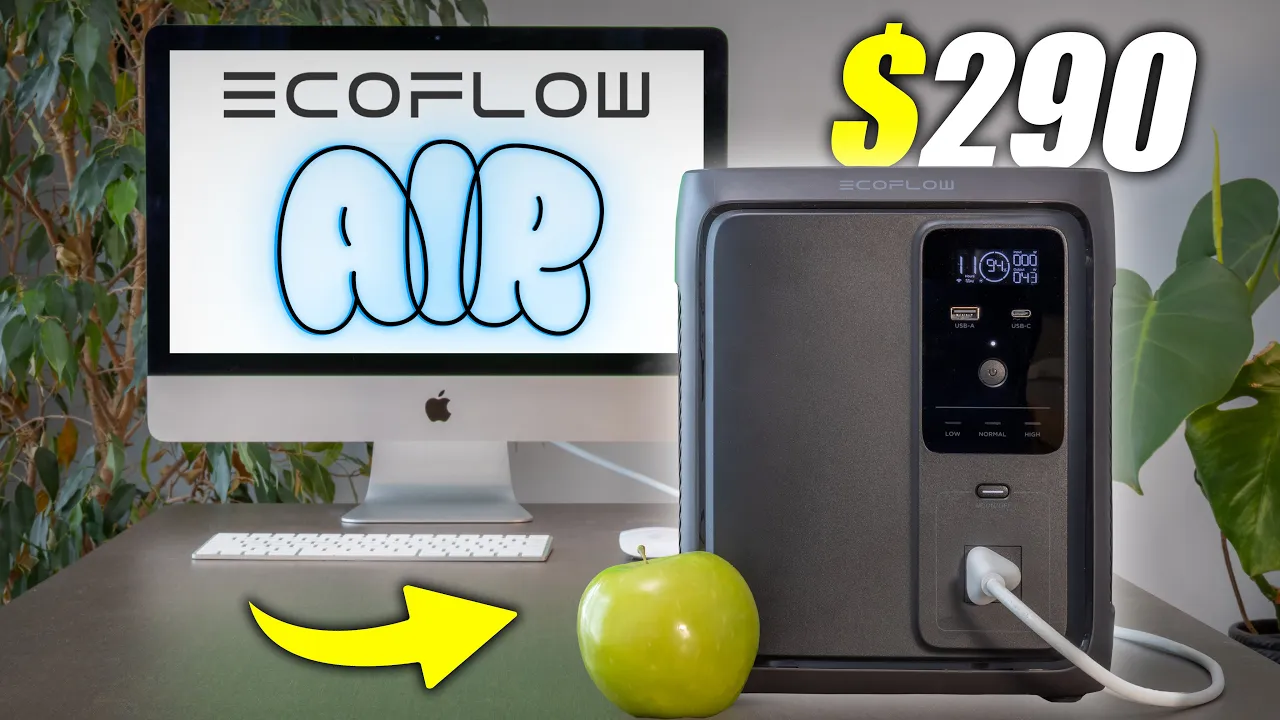
The brand new EcoFlow DELTA 3 1000 Air isn’t exactly what most people picture when they hear the word “Air.” It’s not thin, it isn’t sleek, and it’s definitely not a lighter version of another EcoFlow power station in the same way something like an Apple MacBook Air is. Instead, EcoFlow leaned into a different interpretation of “Air” here: by giving you fewer ports, fewer features, and a much more focused purpose.
EcoFlow’s product lineup has become increasingly confusing over the last year, with overlapping names and wildly different capabilities hidden behind similar branding. We’ve already made an entire breakdown explaining which EcoFlow units actually make sense, but today, we’re narrowing in on one very specific product: the EcoFlow Air.
This is a small, UPS-focused portable power station designed to do a handful of things well, rather than everything halfway. The question is whether that trade-off makes sense for real-world use. Let’s find out.
Before we dive deeper into the real-world performance you get with the EcoFlow DELTA 3 Air, here’s a quick look at what this unit offers on paper:
{{review-summary}}
Thanks to its compact and simplified design, as well as the fact it only weighs 22 pounds, the EcoFlow Air is incredibly portable. However, despite its small size, it still packs a 960Wh battery, which is surprisingly large considering the 500W inverter it’s paired with. While 500W may sound limiting, we actually found it to be a practical output when we were testing the unit.
Charging options are straightforward but well thought out. From a standard household wall outlet, we found it charges at about 650W. Where things get interesting is when the unit is used in UPS mode. Since the inverter maxes out at 500 watts, EcoFlow allows the unit to continue charging while under load. If you’re pulling the full 500 watts and plug it into the wall, you’ll actually be able to hit a total input of roughly 1,200W, which is really impressive for a unit this size.
Solar charging is supported up to 500 watts, which isn’t bad, especially if all you plan on using is a folding solar panel or two. With the right panel setup, you should be able to fully recharge this unit in around two hours with solar.
When we first heard that EcoFlow was adding a new “Air” unit to their product line, we assumed it was going to be some sort of super-thin alternative to the EcoFlow River 3.
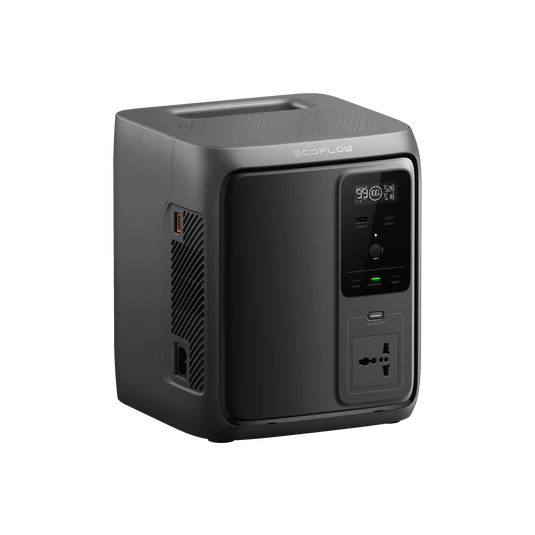
However, the only area where the EcoFlow DELTA 3 Air really slimmed things down was in its minimalist port selection. On the front, you get just a single AC wall outlet, one 12W USB-A, and an 18W USB-C. On the side, there’s an AC input and a solar input. And that’s it. No extra AC outlets, no additional USBs, no 12V car socket, and no expansion ports.
EcoFlow clearly wasn’t trying to make this a do-everything power station. Instead, the EcoFlow Air is intentionally stripped down. The design itself is still very much what we’ve come to expect from the EcoFlow brand: clean lines, a compact footprint, a rear handle for easy carrying, and the familiar EcoFlow screen, but everything is just scaled down.
One genuinely new and interesting feature is the input stability indicator. If you’re charging from an unstable power source, like a generator with inconsistent output, or you plan on traveling with it to countries with different outlet voltages, the EcoFlow DELTA 3 1000 Air will warn you.
That’s something we haven’t seen EcoFlow implement before, and it’s a smart addition we hope they add to some of their other power stations, especially the larger units that work well with gas generators.
Like pretty much all of the newer EcoFlow power stations, the EcoFlow Air connects to the EcoFlow app. The app experience is really simple and user-friendly, which makes sense for a power station this small. You can turn outputs on and off, change a few settings, and make sure firmware stays up to date.
One unique app feature you get with this unit relates directly into that input stability system. If you are traveling internationally and try to charge the unit with an outlet that has a different voltage, you can manually set the expected frequency in the app. That ensures the EcoFlow 1000 Air charges correctly and protects itself from unstable or incompatible power sources.
Honestly, practical app connectivity, a sizable battery, and rapid charging means this unit actually does bring a lot to the table, especially when you take that $293 price tag into consideration.
Now that we’ve provided a pretty thorough overview of what this unit brings to the table, let’s get into how it performed during our testing.
It’s such a small and simple unit, so we didn’t really expect much, but the testing performance actually ended up being where the EcoFlow DELTA 3 1000 Air really excelled. We measure the efficiency at 88%, which earns it an A+ by our grading standards. Now, we expected a unit with a 960Wh battery and 500W inverter to be fairly efficient, but it’s still nice to see that play out in real-world testing.
Unfortunately, where the DELTA Air kind of let us down was its relatively high idle rate. With everything unplugged and the unit’s inverter and screen left on, we measured idling at around 14W. That isn’t the end of the world, but it’s pretty high for such a tiny unit.
For comparison, units like the Bluetti Elite 100 V2 and Bluetti Elite 200 V2 sit closer to 8 watts while idling, and they both offer far more ports and features.
The 10ms UPS feature works exactly as advertised. Switchover is fast and reliable, making this a solid option for computers, routers, and networking equipment. The real standout is the charging behavior under load. Even when pulling the full 500 watts, the unit can continue charging aggressively, meaning you’re not just treading water—you’re actively gaining runtime.
This makes the EcoFlow Air especially useful for unstable grids or frequent short outages, where most small UPS units would slowly drain instead of recovering.
One pleasant surprise is that the EcoFlow DELTA 3 Air works with EcoFlow’s Alternator Charger, an accessory originally designed for much larger power stations. That means you can charge this unit directly from your vehicle’s alternator while driving, making it a solid companion for road trips, camping, or van setups.
This is especially notable because smaller EcoFlow units, like some models in the EcoFlow River lineup, don’t support accessories designed for larger systems. The fact that the EcoFlow Air does adds flexibility for users who already own EcoFlow gear.
Here’s where we think the EcoFlow DELTA 3 Air shines (and where we think there’s room for improvement):
The EcoFlow DELTA 3 Air isn’t trying to be the best portable power station for everyone. And honestly, that’s one of its strengths. It’s purpose-built for users who prioritize battery capacity and simplicity over raw output power or port selection.
With an 88% efficiency score, this unit punches well above its weight, especially considering its relatively small 500W inverter. Pairing that inverter with a 960Wh battery results in a pretty solid runtime, especially since the limited number of ports means you’re probably only going to run a single load at any given time, which is exactly what this power station is designed for.
The 10ms UPS switchover that EcoFlow included in the branding for this unit worked really well in our tests. This makes it a genuinely solid backup power station for a computer, router, or other sensitive electronics that don’t tolerate interruptions or voltage surges.
We also really like how the EcoFlow Air handles charging under load. Being able to pull the full 500W while still actively charging from AC is something many small power stations struggle with. In real-world backup scenarios, this means you’re not just maintaining runtime, you’re actually recovering battery capacity during short outages.
Another thing that really surprised us about this unit is its compatibility with EcoFlow’s 500W and 800W Alternator Charger. While EcoFlow mostly designed these accessories for their larger power stations, it adds flexibility for vehicle-based charging and makes the EcoFlow Air more appealing for road trips or mobile setups.
Speaking of charging it at varying rates, the new input stability indicator is another smart addition, especially for users charging from generators or inconsistent power sources. Again, it’s hopefully something that we’ll see on all of their upcoming portable power station releases.
While there was a lot to like, no power station is perfect, and this little unit does have a few issues:
The biggest downside of the EcoFlow DELTA 3 Air is how limited the ports are, both in number and variety. Even for a minimalist power station, only having a single AC outlet, one low-power USB-A, and an 18W USB-C feels really restrictive.
Beyond the fact that you only get two of them, the USB ports are also underpowered. We really noticed this with the USB-C port, which only outputs 18W. This is underpowered for modern devices and means you’ll struggle to charge something like a laptop while you are using it. Sure, you’ll be able to keep the laptop running, but you’re not going to see its battery charge climb.
Something like a basic laptop pulls closer to 70W while charging from a house outlet, so you’re going to have to use the EcoFlow DELTA 3 Air’s main AC plug, rather than being able to charge directly with DC power from the USB-C.
Noise is another weak point. For a small, UPS-focused unit, the EcoFlow Air is noticeably loud when charging and outputting power at the same time. This makes it less appealing for quiet home offices or overnight use.
Not only did we find this annoying, we found it really surprising, as making quiet power stations is kind of EcoFlow’s thing. For example, their DELTA Pro Ultra is one of the quietest units we’ve ever tested, and that thing was designed for whole home backup!
We mentioned the fact that we found this unit to use around 14W just idling, and that’s something that we really don’t like to see. While a 960Wh battery is pretty good for such an affordable power station, you’re going to burn through that stored power pretty fast if you leave it switched on.
The lack of a 12V car socket and the absence of an LED light slightly hurts this unit when it comes to using it as a piece of camping equipment. Without a 12V plug, you can’t run 12V camping accessories, like a 12V fridge.
During blackouts and off-grid camping trips, having lights available also helps with useability. You can see where you’re going if you’re carrying the power station, or just navigate the plugs if you’re using it in the dark.
Unlike the EcoFlow River 3 Plus or the Anker C300X, which both come equipped with lights, the DELTA Air gives you nothing. Even something like the Pecron F3000LFP gives you glow-in-the-dark buttons, so you can see what you’re doing in the dark, even if it doesn’t have a built-in LED.
The EcoFlow DELTA 3 1000 Air makes the most sense for users who are running one specific appliance or device and care more about runtime than peak power. If your goal is to run a fridge during outages or keep home office equipment online with a fast UPS switchover, this unit does that very well.
It’s also a good fit for small travel setups where simplicity matters more than flexibility. As long as you’re okay with some fan noise and limited port variety and output levels, the EcoFlow Air delivers reliable, efficient performance.
For everyone else, especially those who want a more traditional portable power station for home backup, there are better-rounded options available from other brands, as well as EcoFlow themselves. But if you understand its limitations and fall squarely into its target use case, the EcoFlow DELTA 3 Air does exactly what it promises (and pretty much nothing more).
We test solar products so you don’t have to. Check out our opinions and which units we think are worth your money and which ones aren't.
More Reviews >