The Jackery Explorer 1500 Ultra Portable Power Station is a big departure from what we’ve seen from Jackery in the past. While most Jackery power stations have been reliable and well-built, few have that wow factor that we sometimes get with units from EcoFlow, Anker SOLIX, and Bluetti.
However, with its rugged new design, upgraded durability, and performance numbers that actually live up to the marketing, this latest Jackery Explorer power station might be the first unit the brand has released that feels like a true evolution rather than just a boring variant.
To help you decide if this new Jackery portable power station is actually worth your hard-earned cash, we’re going to break down what’s new, what’s good, and what’s frustrating. We’ll also cover the results of our own performance testing.
Before we jump into our first impressions and the results of our own testing, here’s a quick look at what the Explorer 1500 Ultra is supposed to bring to the table:
{{review-summary}}
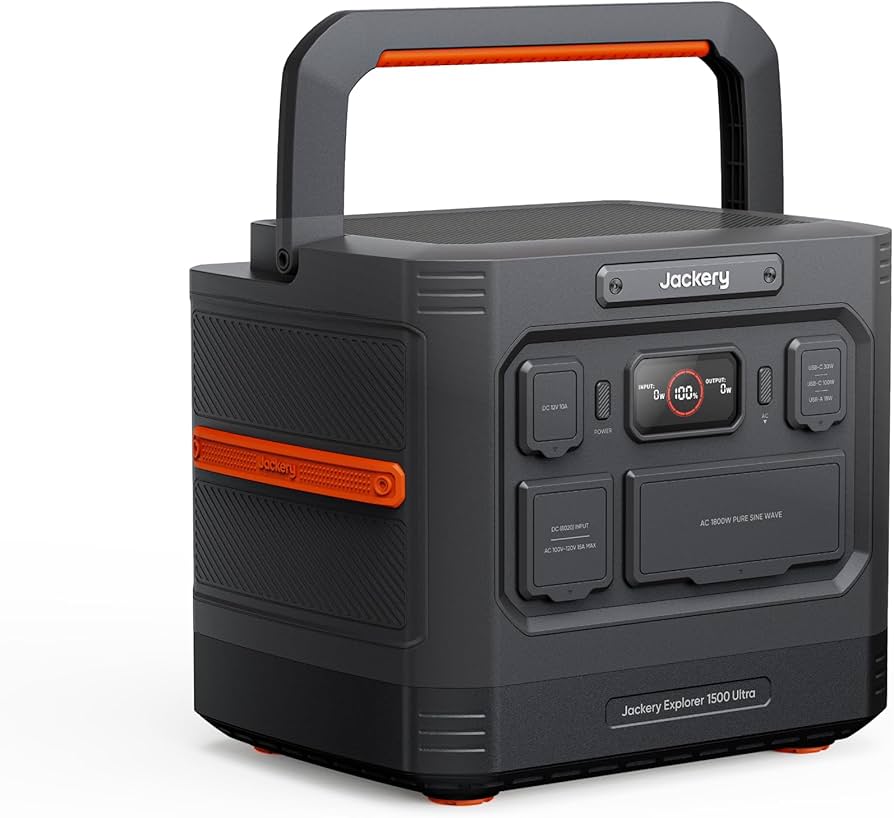
The Explorer 1500 Ultra features a bold all-new look for a Jackery power station. Even from first glance, it’s unmistakably different from every Jackery solar generator that came before it.
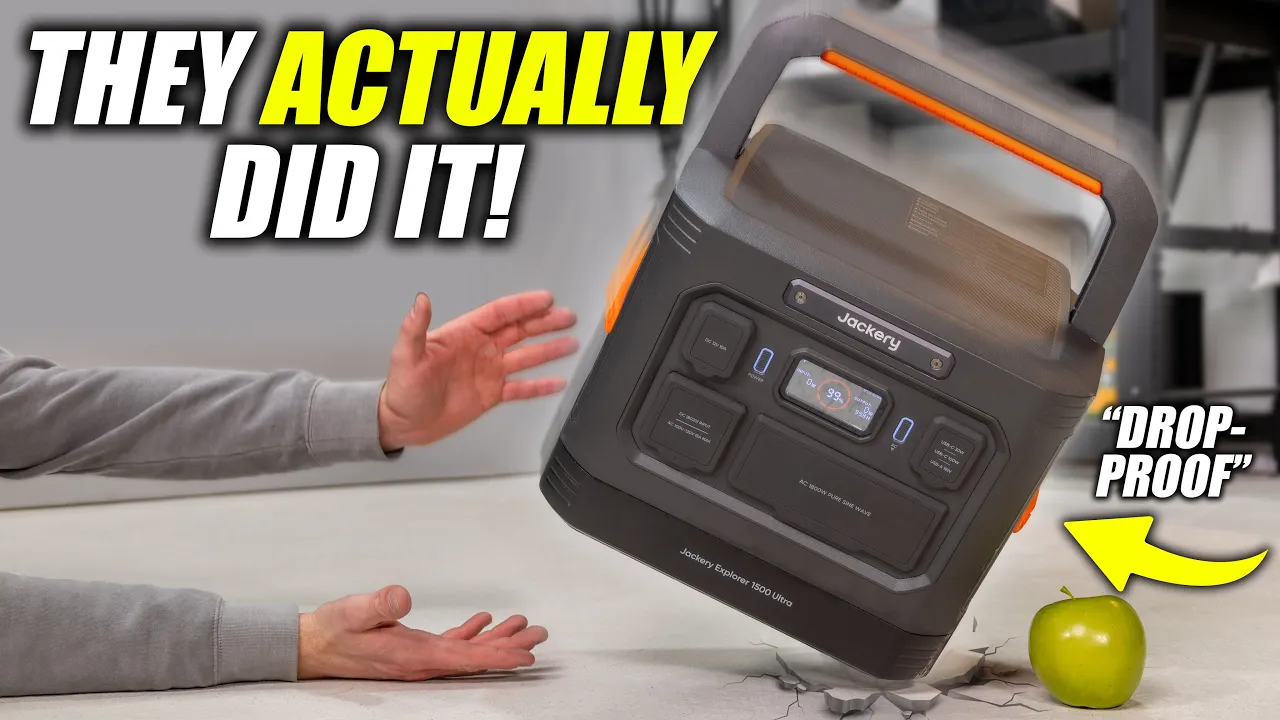
That’s not overly surprising given that Jackery is marketing this as one of their toughest power stations yet. That claim is backed by the fact the entire unit has a IP65 dust and water resistance rating. It’s also supposed to be able to withstand drops from a height of 1 meter, or about 40 inches (more on that later).
One of the weirdest claims Jackery makes is that this unit has a “Level 9 Seismic Shockproof Rating”. Now we don’t have the ability to fly down to California and hope an earthquake hits so we can test the seismic rating, but either way, the unit does feel really sturdy.
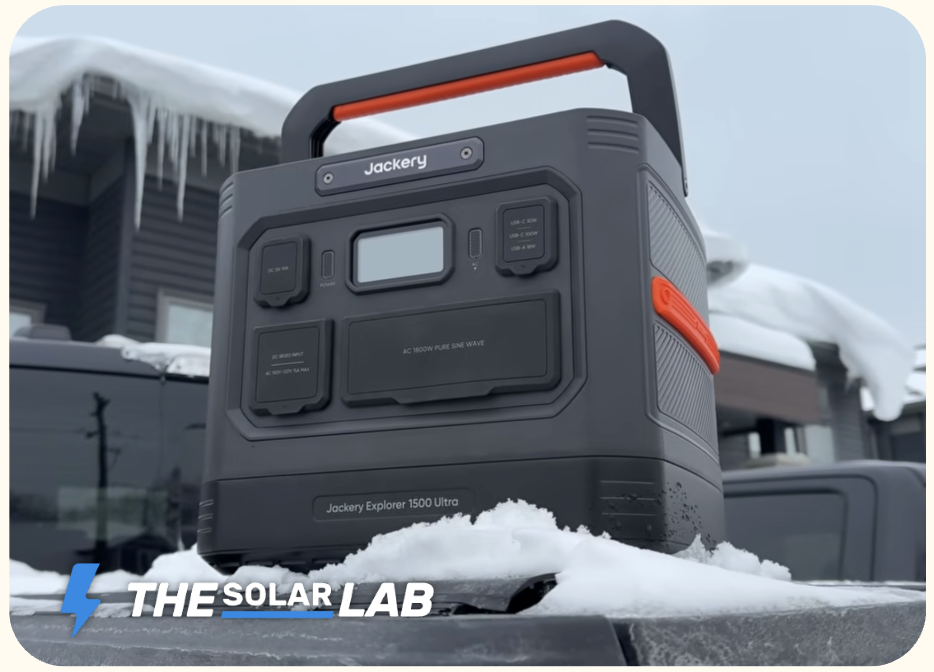
Jackery retained their classic top handle, which is a practical and comfortable design. They added grippy rubber feet to the bottom of the unit, and they seem capable of keeping it firmly planted when you’re plugging things into the front ports. Those rubber feet seem insignificant, but from our own experience testing hundreds of portable power stations, it’s a legit quality-of-life detail that you’ll notice when you’re using it in the real world.
The display screen is classic Jackery: bright, easy to read, and functional. The app experience is also familiar. You can use it to turn the ports on and off, update the firmware, and adjust settings that you can’t control on the unit itself. It’s not flashy, but it works.
Just purely in terms of the aesthetics, the industrial look of this unit was a bit divisive at The Solar Lab. Robbie thinks it looks cheap and has major Temu vibes, while Mr. Health and Safety actually likes the design and thinks it would look great in a workshop. Both are fair takes, and you’ll have to decide for yourself if you like the design. However, what actually matters is how it performs. So, let’s take a look at how this thing stood up to our testing.
Now that we’ve got you up to date with the basics, let’s see how well this latest Jackery power station actually handles real-world testing:
One of the first things we had to test was Jackery’s claim that this is one of the most durable and rugged power stations money can buy. This features heavily in the marketing for the 1500 Ultra, and it’s clear Jackery wanted to use the durable, water-proof design as a major selling point for this model.
To test that 1-meter drop-rating, we dropped the Explorer 1500 Ultra from at least that height onto grass and concrete from the bed of a truck, a workshop table, and the backyard balcony. It suffered a few scratches and a bit of light cosmetic damage, but it survived every drop test and continued to function as it should.
We then tested the IP65 rating by spraying the entire unit down with a hose and throwing it in a snowbank. Turns out that the water-resistance rating is legit. The port flaps also did a great job of sealing out moisture. Even when you have them flipped open, the port covers act like mini awnings that deflect water away from the inputs.
This isn’t the first time Jackery has leaned into the durability angle, and they actually marketed the Jackery Explorer 2000 V2 as an “unbreakable” power station. Unlike those claims, which turned out to be flimsy at best, the Explorer 1500 Ultra actually does feature a legitimately heavy-duty design that would have a lot of practical benefits.
After using this power station over the course of several days, we were blown away by one thing in particular: how incredibly efficient it is. In fact, when we measured it, we found a 98% efficiency rating. That’s the highest we’ve ever recorded for a power station from any brand.
We suspect that part of the reason why it’s so efficient is the way that Jackery redesigned the cooling system for this unit. Instead of having fans and vents lining the sides of the power station, which is what older Jackery models had, the 1500 Ultra pulls air in from the bottom and spreads it over cooling fins.
The result of this new underside cooling? This Explorer 1500 Ultra isn’t just efficient, it also runs very quietly compared to almost every other Jackery power station we’ve tested. Again, this is a big win if you’re planning to use your power station indoors for home backups, or even inside a tent or RV while you sleep.
The charging performance was solid too. Using a standard wall outlet, we were able to charge the Jackery Explorer Ultra from 0% to 100% in about 1 hour 21 minutes. We didn’t hit the lightning speeds we’ve seen from other brands, even when we flipped it into “Fast Charge Mode” with the app, but it still charges fast enough to be a practical option for a lot of real-world scenarios.
While an 800W solar input isn’t the best we’ve seen in a unit of this size, the dual 400W solar ports worked well. Having the two ports, rather than a single solar input, also means the unit pairs nicely with the 400W Jackery solar panel. You can easily plug in one or two panels, without having to worry about wiring them together.
The unit’s surge performance was impressive as well. We were able to exceed its 1,800W inverter rating without issue. That gives you a bit of headroom for starting up heavier loads than the continuous output rating suggests.
We then measured the idle consumption at about 21W, which is a bit high compared to some similarly sized competitors, but that still translates to around three days of standby power if you’re not pulling anything from the ports. For perspective, the Bluetti Elite 200 V2 has an idle rate of 9.2W, so 21W is definitely not the best we’ve seen, but it’s not terrible for a unit this size.
While no power station is perfect, there’s a lot to praise with the Explorer 1500 Ultra. Here’s the main positives that stood out to us:
Jackery’s claim that this is an incredibly durable and rugged power station actually checks out when you test it. We dropped it repeatedly from heights that would shatter other power stations, soaked it with water, and just generally treated it about as rough as we’ve ever treated any unit.
All of this abuse didn’t faze it, which is something we think a lot of buyers are really going to appreciate. If you wanted a power station you could toss in the back of your truck to use while camping or on a job site, the Jackery 1500 Ultra could just be the ideal option.
Beyond durability, it also features a design that is genuinely practical. Between the pop-up handle and the 38 lb build, it’s really easy to transport this little unit where you need it to be. The addition of the port covers and the gripped feet on the underside of the unit also help a lot when it comes to real world use.
The 98% efficiency rating is the best we’ve seen from any power station we’ve ever tested. That’s something we really appreciate, especially in a mid-sized power station.
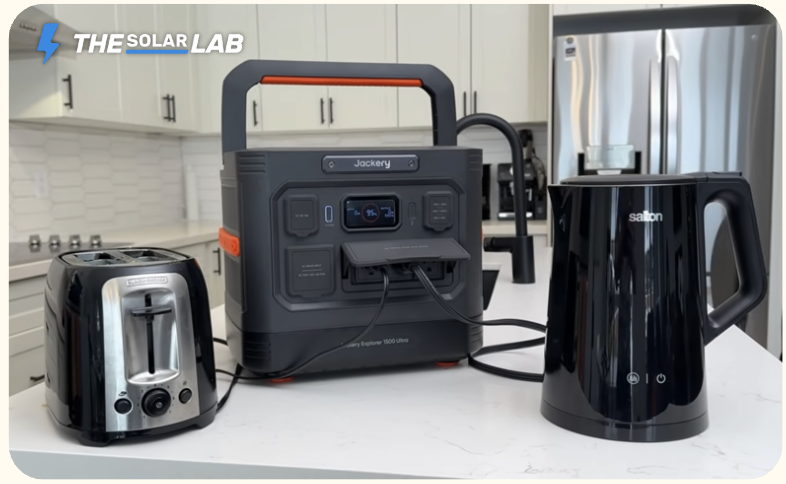
When you’ve only got about 1,500Wh to work with, you want to make sure that the vast majority of that power is actually going to end up running your appliances and devices. With the 1500 Ultra, that’s actually the case.
Even when you’re running it under load, like all of the surge tests we ran, it stays surprisingly quiet. While a lot of Jackery power stations have impressed us in the past, including the high-performance Jackery Explorer 5000 Plus, they’ve always been a bit on the loud side. Where DJI and EcoFlow power stations tend to be whisper-quiet, Jackery power stations have always seemed to produce an annoying buzzing sound.
Thanks to the decision to use cooling fins and an underside fan system, the Jackery 1500 Ultra is one of the quietest Jackery power stations we’ve ever tested. That’s a huge plus and hopefully a sign of things to come from the Jackery brand.
For a unit of this size, it comes with a nice array of properly spaced output ports. You get plenty of AC plugs, as well as a 100W USB-C, so you can easily run something like a fridge, while still having the option to fast-charge your phone directly from the unit.
The decision to retain the 12V car socket is another great inclusion, especially if you’re looking for a power station you can use for camping, RV trips, and just using any accessories that rely on 12V.
Cleaning the 1500 Ultra is surprisingly easy too. The base unscrews to expose the fan area, so you can easily clean dust and debris out if needed. When we cleaned it, we just opened the bottom and took advantage of the unit’s IP65 rating. We sprayed it down with water from the kitchen sink, and all of the dust that had built up over our tests flushed clean.
Designing the unit so you can easily clean the fans out is a thoughtful touch, but it also highlights a potential downside for this unit that we’ll discuss below.
Just like every power station we’ve ever tested; we found a few issues with this unit. While we didn’t encounter any deal-breakers, here’s what stood out to us:
Jackery used to be one of the few brands that reliably included a built-in light on all of their power stations. Removing it feels like a downgrade, especially when you’re talking about a unit that was clearly aimed at outdoor and emergency use. They even had a light on the older Jackery Explorer 1500 V2, which makes removing it seem even more bizzare.
The illuminated buttons are a neat touch, but if it’s dark, and the unit is switched off, those buttons don’t help you find it. Even going with glow-in-the-dark buttons, like you get with a lot of Pecron power stations, would probably help here.
The removable base and bottom intake design are clever, especially when it comes to cleaning the fan, but it also means if you’re using this at the beach or on dusty ground, you’re going to pull grit straight into the intake.
Yes, you can wash it out, but it’s better not to need to in the first place. It’s a trade-off, and the design will work really well for those planning to use it for power inside their home or office, but it’s something to consider if you want to use it outside.
Jackery claims a 1,800W AC charging speed, as well as a “Fast Charging Mode” that is accessible through the Jackery App. However, even that fast mode doesn’t slash charge time dramatically.
We’ve seen other portable power stations, like the Anker SOLIX C1000 Gen 2, that can go from 0% to fully charged in half the time, which matters when you’re in a hurry.
A 21W idle draw isn’t the end of the world, but a lot of power stations in this class idle closer to 10-15W.
If you’re hoping to use this power station for intermittent loads, like running a refrigerator, losing storage capacity to a relatively high idle rate is going to become a bit of an annoyance.
It’s not going to be an issue for everyone, but we would have liked it if Jackery launched an expansion battery alongside this unit. If you’re looking for a power station that can grow with you, you’d probably be better off with something that enables you to increase the battery capacity.
This unit isn’t going to be for everyone, but it does make a lot of sense in a few key categories:
This unit enters one of the most competitive classes in the portable power game. It’s far from perfect, but it’s easily the most robust and durable unit we can think of. If you like to put your gear through its paces, you might find the Explorer 1500 Ultra is the perfect power station for your needs.
The Jackery Explorer 1500 Ultra is one of the few Jackery models that actually feels like a meaningful upgrade over its predecessors. It takes a far more rugged approach than we’ve seen from Jackery, then backs up those claims with a genuinely rugged design.
It also delivers best-in-class efficiency, and a practical array of output and input ports. It’s not perfect, especially if you want ultra-fast charging or a power station that supports expansion batteries, but this is definitely a Jackery power station we feel comfortable recommending.
We test solar products so you don’t have to. Check out our opinions and which units we think are worth your money and which ones aren't.
More Reviews >