When people ask us, “How many batteries do I need to power my house?” they usually want a simple number, or a one-size-fits-all reply, like “just get this one thing and you’re good.”
But that’s just not how home battery backup systems work. Everyone uses power differently, every home has different peak days, and when it comes to charging those batteries with solar, every region has different amounts of sunlight each day. The good news? Figuring out the right home battery setup is easier than you probably think, and you don’t need to be a certified electrician or engineer to understand it.
Here at The Solar Lab, we don’t just want to help you find the best products, we want you to understand how solar equipment works. So, we're going to explain how you can calculate your own unique home battery requirements. We’ll use real-world scenarios and explain how you could meet those needs with batteries that we’ve actually tested. Let's get started.
Determining how many batteries you need, and knowing which types will help you meet those needs, is actually a three-step process. Don’t worry, each step is pretty straightforward.
Plus, doing it this way means you’re not just guessing. This means you won’t be buying a battery that isn’t big enough for your requirements, or wasting money on something that is storing a lot more power than you actually need.
The first step is simple: look at your electricity bill. It should show you your total monthly power consumption, which gives you a rough daily average. For example, Robbie’s November electricity bill said he used 469 kilowatt hours (kWh) that month, which works out to about 15.6 kWh if you divide it by 30 days.
But here’s the catch: monthly averages hide the days your electricity usage spikes, as well as days it drops lower than normal. These could be days when your AC never shuts off, or when you have guests staying over, or even when you decide to cook up a storm and deep-clean the whole house, so you were running every appliance at the same time.
Once Robbie took the time to check his daily breakdown, rather than just calculate an average, he found that most days were moderate, but some spiked well beyond that 15.6 kWh he estimated.
This was also in November, when electricity usage is pretty standard. When he went back and checked the summer months, he found some of the highest days hit over 40 kWh!
For context, the average U.S. home uses 10,500 kWh of electricity in a year, or roughly 30 kWh per day. This means that Robbie’s big summer days weren’t abnormal, 40 kWh is just realistic.
If the thought of looking into your power usage and calculating numbers seems like an overwhelming mess, you can just use 30 kWh/day as a baseline average. It’s probably going to come close enough that it will be a practical amount of stored power for most power outage scenarios.
If you want to accurately plan so you can build a system that’s guaranteed to meet your needs, check your highest day on the hottest (or coldest) month of the year and use that number (rather than an average).
This will guarantee that the rest of the year’s power usage will fall comfortably below your battery capacity. Finally, if your goal is emergency essentials only, you can usually cut your number in half, as essentials typically run around 15 to 20 kWh per day depending on your home.
When we say emergency essentials, we’re talking about enough power to run a fridge, CPAP machine, lights, and charge phones. You’re not going to be blasting your oven and AC in an emergency (well, you shouldn’t).
If you’re building out a system for an off grid property, like a tiny home, remote cabin or homestead, you can also just calculate your anticipated power requirements using our Power Consumption Calculator. It takes a bit of time, but it’s worth being thorough if you want to make sure that your off grid battery system can actually meet your specific power requirements.
A lot of people overlook this step, but it’s actually where everything starts to make sense.
Ask yourself: “Am I preparing for full-time off-grid living… or for emergencies and blackouts?” There’s no wrong answer, but your specific goals will determine how much power storage you actually need.
Where we live, power outages aren’t frequent, but we usually get at least a couple per year, including one big one. And last year, an ice storm left us without power for four full days, so we will use four days as our planning window (when it comes to emergency prep, it’s always a good idea to prepare for the worst).
Using the earlier 40 kWh number we calculated for Robbie’s worst days, this is how a four-day outage would shake down:
Both numbers seem really high, and they are, but that’s also because we haven’t reached Step 3 yet.
This is another step a lot of people overlook. The truth is, you only need multi-day battery storage if you’re expecting multi-day outages with no way to charge your batteries. If you have solar panels, as well as reliable sunlight you can access, you’ll be charging your batteries during the outage.
For example, let’s take somewhere like Florida, where a storm can hit in the morning and knock the power out, but then that same afternoon can be sunny (there’s a reason they call it The Sunshine State).
You probably only need 1 or 2 days of battery storage because even after a storm, sun often returns quickly. Even if the grid was out, a solar panel array could refill the batteries almost every single day.
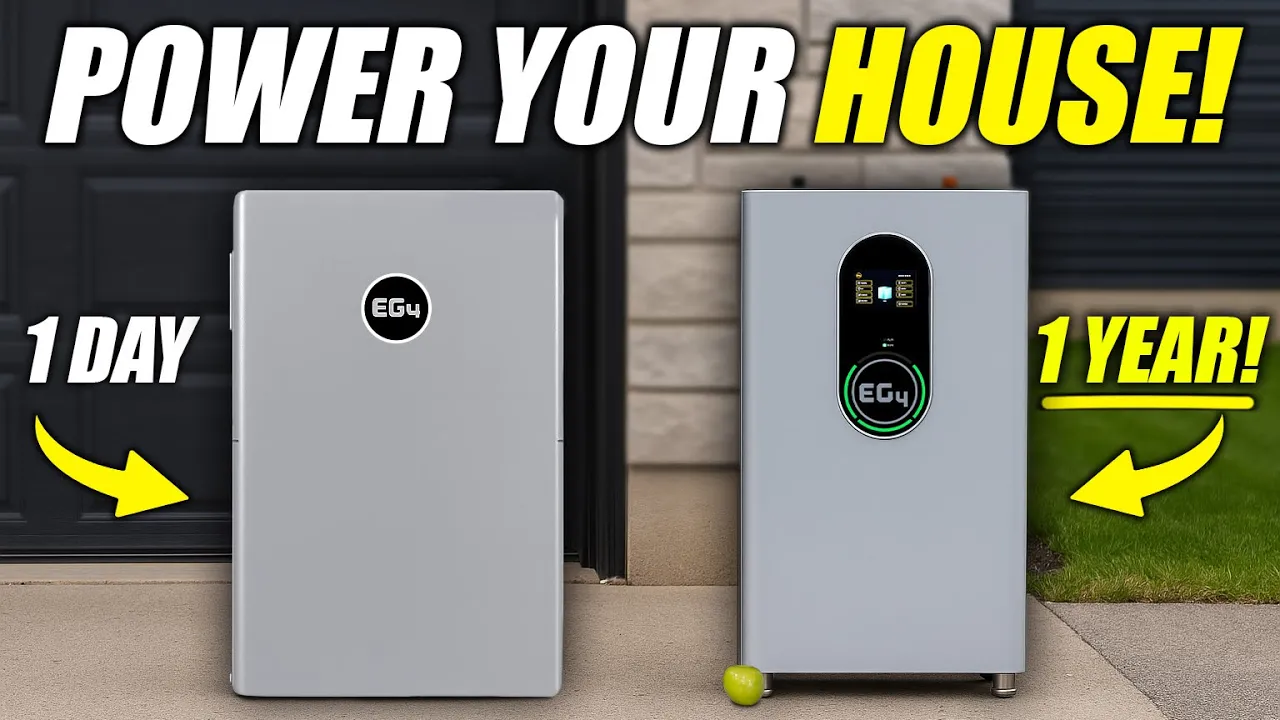
Using the 40 kWh example, if you only need two days of storage (80 kWh total), you could cover those needs with six EG4 Indoor WallMount Indoor 280Ah Batteries. You could also slash the number of batteries in half if you were only running the essentials during the outage.
If you have solar panels, but unreliable sunlight, like in the Northeast, Midwest, Pacific Northwest, or basically anywhere with long storms or winters, you wouldn’t be able to depend on your solar array after a storm. This is because days can pass without usable sunlight.
For people without reliable sunlight, you have two options: increase the amount of battery storage you have available, or consider a hybrid solution with grid charging before an outage or a gas generator while the grid is down.
If you charge with the grid or a generator, which is what we often do during the winter months, you can fully charge your batteries from the grid so that when the power goes out, you start with 100% capacity.
Then, if the outage lasts several days, you top the system off using a gas generator, but you only have to run that gas generator for a short time.
This is surprisingly efficient. For example, using a 6,500W Champion Generator, you only need 2 to 3 hours of runtime to recharge two of those above-mentioned EG4 280Ah WallMount Batteries (20 kWh essentials setup), or four EG4 100Ah Indoor WallMount Batteries (also enough battery capacity to run essentials).
Once you’ve topped your batteries up, you can shut your gas generator down and enjoy quiet battery power again.
If you’re wanting to prepare for a full 40 kWh day, you’d only need something like three 14.3 kWh EG4 Indoor WallMount Batteries for a single day of storage, as your gas generator would be able to reset your battery bank to 100% each morning.
Not only is this hybrid approach easy to do, quiet, and relatively fuel-efficient, it’s significantly cheaper than building a multi-day backup battery system.
Here’s the simplest way to summarize the entire process:
Typically, 20 to 40 kWh per day (check your utility bills to know your own daily power usage). Again, being prepared for the days where you use the most power will ensure that your battery backup system can easily handle the other days.
Are you prepping for a single day, or do you need multiple days of off grid power? Only needing off grid power for a few hours during a small outage is a lot different than being prepared for a multi-day blackout or disaster situation.
You can go with wall-mounted batteries or server rack batteries. You could even choose a big power station instead. Your budget, available space, and personal preferences will come into play here. Once you know how you will store power, you can decide how you'd like to charge those batteries up during an outage. You can charge them before the outage with grid power (you'll need a greater storage capacity), or you can charge them throughout the outage, either with solar or a gas generator.
Whether you choose EG4 server rack batteries, like the EG4 LL-S or LifePower4, or you go with wall-mounted options, you get something rare in this industry: legitimate customer support, especially if you order through Signature Solar (EG4’s main retail partner). If you have a question, someone answers. And, if you have a problem, someone actually helps.
Warranty issues? They don’t vanish into the void. Signature Solar’s customer service is really solid, and we’ve mystery shopped them in the past to check for ourselves.
There are definitely cheaper battery brands out there, and we’ve reviewed a lot of their products, but many of those companies disappear the moment something goes wrong. If you’re on a tight budget, something like the RUiXU Server Rack Battery could do the trick, but don’t be surprised if you’re given the runaround if something goes wrong.
We see it all the time, and it’s why we only recommend brands we trust.
Once you know how much battery capacity you need, and you’ve decided which type of batteries you want to go with, your next step is sizing your inverter, solar panel array, and deciding which wiring method makes the most sense.
We actually have separate guides that can help you with that:
If you decide you’d rather go with a portable setup, the following guide should help: What Size Power Station Do You Need for Home Backup?
Choosing the right size battery bank doesn’t have to be overwhelming. With a little bit of basic math, taking the time to decide how you plan to use your system, and a realistic consideration of the amount of sunlight you get in your area, you can build a setup that keeps your home running exactly as it should.
If you’re still unsure about what you need, we have a Power Consumption Calculator you can use, as well as a Power Station Quiz, which will quickly recommend the best unit for your needs.
Signature Solar Battery Collection: https://signaturesolar.com/batteries
Use Code: SOLARLABGET50 for $50 Off Your Order
Shop Solar Battery Collection: https://shopsolarkits.com/batteries
Use Code: THELAB for 4% Off Your Order
Explore more practical tips, guides, and insights to help you get the most out of solar
More Resources >