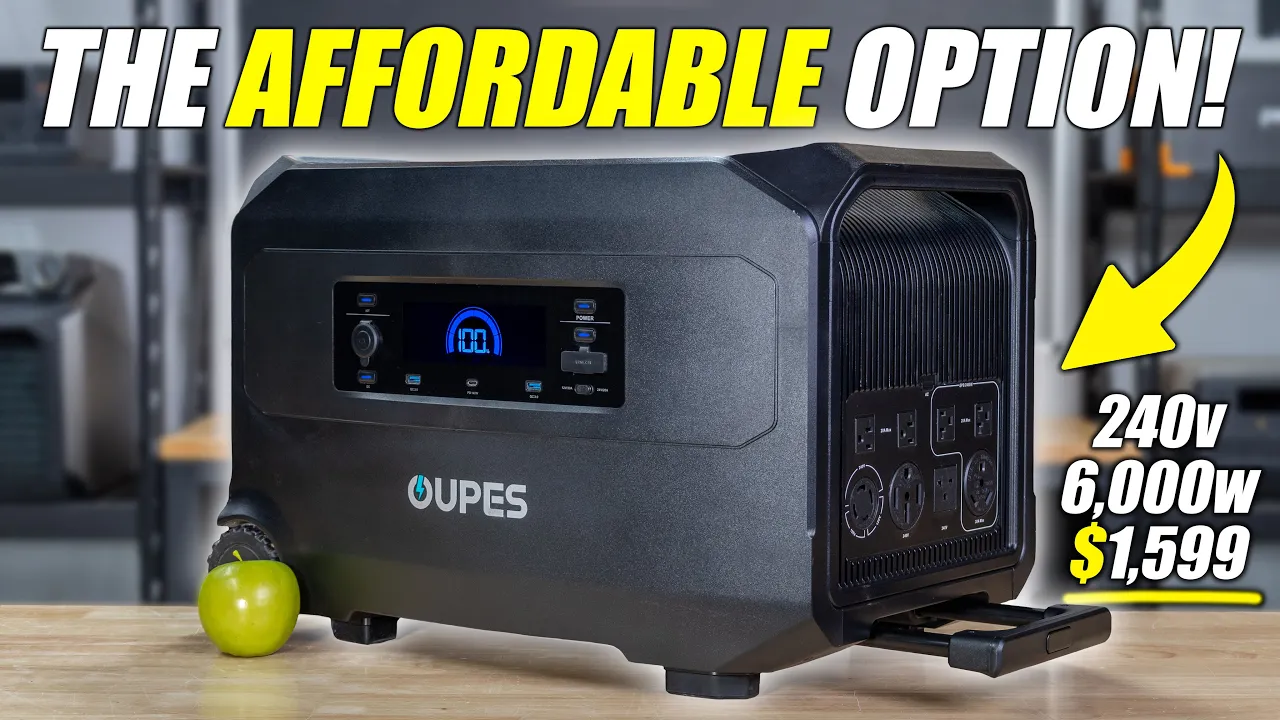
The OUPES Guardian 6000 is one of the biggest leaps forward we’ve seen from OUPES—a brand known for making budget-friendly power stations that work well, but are somewhat limited. While the power stations in the OUPES Mega Series offered good value, none of them could deliver a 240V output, which is why we couldn’t really take them seriously as a home backup power solution.
Now, the new OUPES 6000 stands out as the brand’s first native 240V unit, meaning you don’t need to pair it with a second unit to hit 240V. In addition to being their most powerful model, it’s also the biggest and most modern-looking OUPES power station ever released.
It’s really big, really powerful, and more refined than a typical OUPES unit, but does that make it the best portable power station you can buy for the price? And more importantly, is it actually worth your money? Let’s find out.
Before we jump into our own testing, let’s start with a quick breakdown of what the OUPES 6000 Portable Power Station brings to the table:
{{review-summary}}
The Guardian 6000 is big… really big. At 111 lbs, it barely passes the Tiny Baby Lift Test, and that’s before you add any expansion batteries. It actually dwarfs the OUPES Mega 5, which was the biggest unit they had released up until this point.
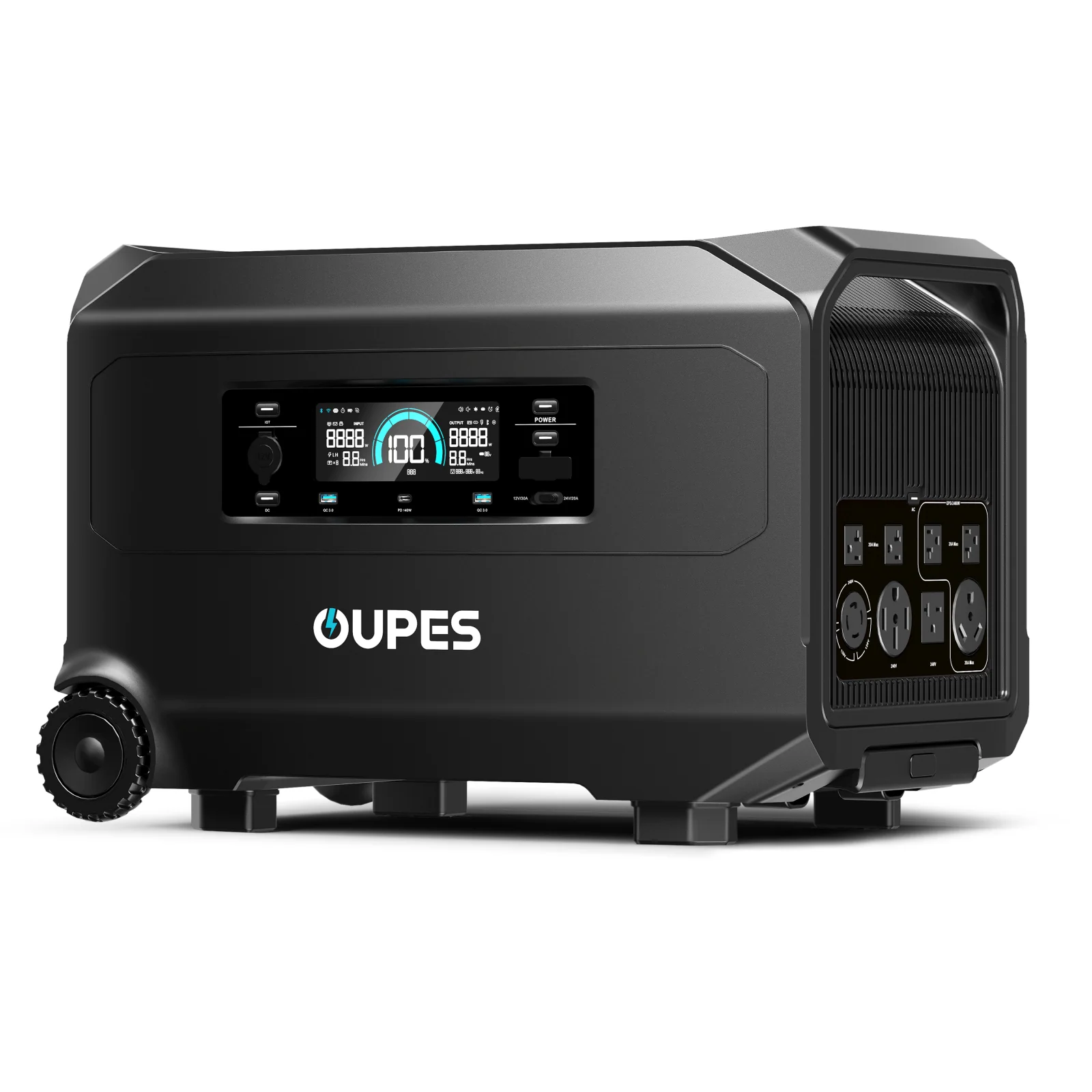
The OUPES 6000 is built almost like a rolling toolbox crossed with a large suitcase, complete with wheels, a pull handle, two heavy-duty lift handles, and thick rubber feet that keep it firmly planted.
It’s bulky and not exactly graceful, but it’s by far the most polished design OUPES has ever released. It has a far more modern aesthetic, and almost looks like they took design hints from some of the older EcoFlow units, like the original DELTA Pro.
The display screen is bright and easy to read, the port layout is cleaner than older models, and the new OUPES app adds real functionality, including scheduled charging for peak shaving.
Aside from having the build of an overfed pig, the Guardian 6000 is a surprisingly user-friendly power station once you’ve rolled it into position.
We’ll discuss everything we like and dislike about the OUPES Guardian 6000 Portable Power Station, but let’s review the results of our own testing first:
We kicked things off with AC charging, because recharge speed is one of the biggest deciding factors for anyone using a power station for home backup.
Using a standard 120V wall outlet, the Guardian 6000 pulled a steady 1,800W and went from 0–100% in exactly 3 hours and 12 minutes. That’s not overly impressive, but it is exactly where a unit of this size should land.
Switching to 240V charging unlocked the full 3,600W AC input, bringing the recharge time down to roughly 1.5 hours, and instantly making the Guardian 6000 one of the fastest-charging budget 240V units we’ve ever tested. That’s a big win when you’re preparing for a storm, juggling charging with a gas generator during an outage, or trying to top up before the grid flickers again.
Solar charging was also about what we expected. OUPES advertises a maximum of 2,400W of solar input, and during testing we consistently hit near the 2000W range in good conditions.
The input remained stable throughout this testing, but we were a bit annoyed that the solar input uses an Anderson port, rather than the more widely used XT60 solar input. This was particularly weird when you consider it does have an XT60 port, but it only functions as an output port for plugging in DC appliances and devices.
We also noticed a charging quirk worth mentioning: when the display screen shows 100% battery and it appears like the unit has stopped charging, it actually continues pulling around 1,000W for around 30 minutes to balance the battery.
This isn’t harmful or overly concerning, but if you unplug it the moment you see the unit say its battery is full, you’re leaving some of its battery capacity on the table. We’d recommend giving it time to finish that balancing cycle, especially if you’re expecting an outage or prepping for an emergency.
Efficiency testing was where the Guardian 6000 surprised us the most. Budget brands often hover in the 70% to 80% range, and that gap becomes noticeable once you’re powering an entire house.
However, we measured the Guardian 6000 to have around an 85% inverter efficiency rating, which puts it in the same arena as more expensive units from brands like EcoFlow and Anker. We typically give any efficiency rating above 80% an ‘A’ grade, so that’s really impressive for a big power station that is priced under $2,000.
On the other hand, idle consumption is one of the Guardian 6000’s weaker areas. With the system powered on and ready, but not actively outputting any power, we measured around a 75W idle draw.
That’s significantly higher than something like the EcoFlow DELTA Pro 3, which idles closer to 40 to 50W. It’s not a deal-breaker, but it does mean you’ll lose noticeable stored energy if you leave it sitting idle during long outages.
Considering the OUPES Guardian 6000 is fairly inexpensive, uses large cooling fans, and has a 6,000W inverter packed inside of it, we expected noise levels to be pretty loud. In reality, it was pretty noisy, but quieter than other budget brands we’ve reviewed.
In our real-world tests, the Guardian 6000 handled 240V loads far better than expected, especially for a cheaper unit. We actually got it to hit close to that 6,000W output without any voltage dips or instability.
That alone puts it in a different league from OUPES’ older systems, which didn’t support a 240V output at all. Even something like the Pecron E3600LFP requires you to connect two power stations together for a 240V output.
We didn’t think we’d see a budget option beat the 2x E3600 240V Bundle, but the OUPES 6000 makes a case for itself.
Now that we’ve covered the basics, let’s jump into all of the things we really liked about this pig-like power station:
OUPES finally built something that feels modern and powerful. The plugs are well-spaced, nothing overlaps, and the layout makes sense. The chunky feet keep it stable, the handles work well, and the wheels are durable enough to make moving 111 lbs slightly less miserable.
This is huge. As mentioned, other budget brands, including Pecron, usually require two units to get 240V. The Guardian 6000 Power Station does it on its own. You also get three different plug options. It works, it’s reliable, and it dramatically improves the value of this unit for home backup and RV owners alike.
The 240V input and output also means you could connect this unit to a transfer switch and enjoy automatic backup power during a power outage. Given its hefty weight and bulk, that probably wouldn’t be a bad idea, especially if you plan on expanding the storage capacity.
Each expansion battery adds another 4,608Wh of storage capacity, and OUPES made it possible to connect up to eight of those batteries to a single unit. This means you can reach a really impressive total storage capacity of 41,472Wh, or 41.4 kWh.
Not only is that a higher expanded capacity than more expensive power stations, like the Anker SOLIX F3000, it means you’re getting into legitimate whole home backup power. It’s still below the EcoFlow DELTA Pro Ultra and Bluetti Apex 300, but given the price, that really isn’t a criticism.
Even some of the best big power stations remove the 12V port entirely, but this OUPES power station retains it. This means you can still run 12V fridges, compressors, and camping gear, which is a huge win for those planning to purchase a power station for RV use or van-life.
85% efficiency, reliable UPS, a nice variety of output ports, a huge inverter, 240V capabilities, a functional app, and a practical design make this easily one of the strongest budget performers we’ve ever tested.
Honestly, it really surprised us. We figured it would be similar to the previous OUPES releases, which were decent, but nothing to get overly excited about.
In our past reviews, we pointed out the fact that OUPES’s customer service struggled… badly. This time around, calling their customer support line actually worked.
They’re definitely understaffed, so you’ll likely hit voicemail, but they called us back within four hours every time we tried. Once you do get a call, you’ll be greeted by an American rep who actually understands the product and can offer legitimate help with any sort of troubleshooting issues. A voicemail and call-back system sounds like faint praise, but it’s a massive improvement.
OUPES also backs this unit with a 6-year warranty, which is crazy, especially for something we’d deem a cheap power station. For full transparency, we’ve never actually inquired about any sort of warranty issue, so we can’t say they’ll actually deliver on that promise, but it’s something.
While there was a lot to like about the OUPES 6000 Power Station, nothing’s perfect, and this unit was no exception:
We mentioned it earlier, but the solar input uses an Anderson connector, meaning most generic folding panels won't plug in without adapters. The strange part? The front of the unit has a standard XT60. Why not just use XT60 for solar, too? Very odd design choice.
Sure, you can easily buy an adaptor, which would allow you to use whatever solar panels you want, but it would be nice if you didn’t have to do this.
This is a minor criticism, but the buttons blend into the casing so much that even an OUPES’ support rep told us some older buyers were calling in confused about how to turn it on. The AC button is particularly difficult to see. It shouldn’t be an issue once you find them, just anticipate a bit of a struggle when you’re first getting used to the unit.
A 111 lb power station with no light is not ideal. In a blackout, two people will be hauling this up a staircase in the dark, and a built-in LED would make a big difference in safety and usability.
Yes, we’ve read the comments on our YouTube videos, and we know a headlamp would help, but it’s an extra step we think is unnecessary. Plus, headlamps can run out of juice pretty fast, and this is a unit that could be used for multi-day power outages.
The unit burns 75W just sitting there turned on. It does make sense given all those different 120V and 240V ports need to stay ready to output power, but that’s a lot of power to burn through when you’re not actually running a load.
You can’t charge it from a regular wall plug while running any 240V appliance. More premium units can do this. Again, it’s one of the areas where the OUPES 6000 shows why it’s a little cheaper than comparable power stations from more mainstream brands.
The display screen lies. Once it hits 100%, we still measured around a 1,000W draw for about half an hour. If you unplug it right away, you’re losing usable battery capacity, which could really be an issue given that high idle rate.
In our opinion, the Guardian 6000 is a fantastic entry-level portable power station for home backup, especially for anyone who wants true 240V output at the lowest possible price.
For around $1,614, you get a scalable system that can grow all the way to over 40 kWh, and it integrates easily into a home via a transfer switch. It competes surprisingly well with something like the EcoFlow DELTA Pro 3 for about $500 less.
While it’s not perfect, it delivers huge value for anyone wanting reliable emergency backup without jumping into the premium brands. It’s a strong, cost-effective option that finally shows OUPES catching up to the big brands, as well as Pecron, our other favorite budget brand.
If you’re still unsure whether this is the best portable power station for your needs, take our 30-second Power Station Quiz. We’ll recommend a power station we approve of that will fit your needs.
We test solar products so you don’t have to. Check out our opinions and which units we think are worth your money and which ones aren't.
More Reviews >