About a year and a half ago, DJI made its first steps into the power station world with the release of the original DJI Power 1000 and the smaller Power 500. And while DJI is a brand known for making drones and camera equipment, the Power 1000 was extremely quiet, well-built, and surprisingly useful. It impressed us so much that we ended up calling it the power station we didn’t even know we needed.
Fast forward to today, and DJI is back with the Power 1000 V2, an updated version of the Power 1000 that promises to deliver faster charging, more output power, and a few other upgrades while keeping the same sleek, creator-focused design.
The big question is whether these updates are enough to make the Power 1000 V2 stand out in a market that’s more crowded than ever. After spending time running this unit through all of our regular testing, the short answer is: it makes a lot of sense for certain buyers, especially DJI enthusiasts and those looking for a dead-quiet power station.
So, let’s see what DJI is bringing to the table with this refreshed V2 version of the Power 1000.
Before diving into our experiences with this updated DJI power station, here’s a fast teardown of the Power 1000 V2’s core specs:
{{review-summary}}
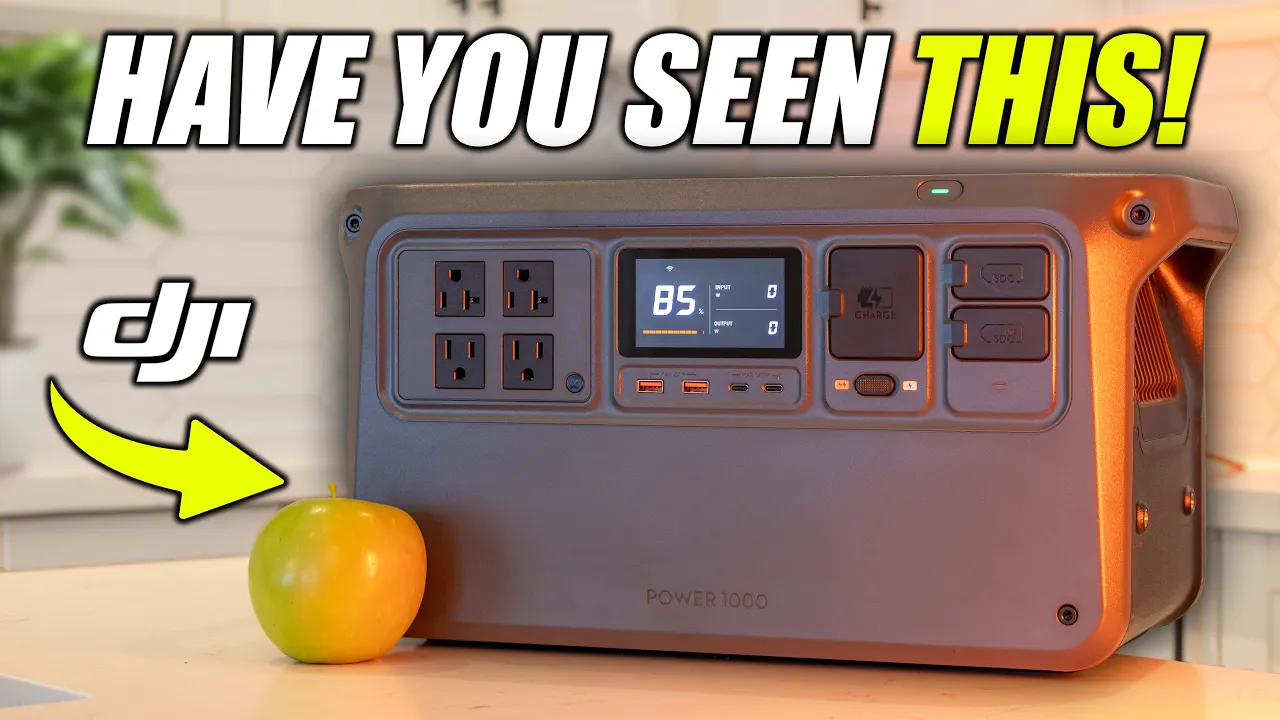
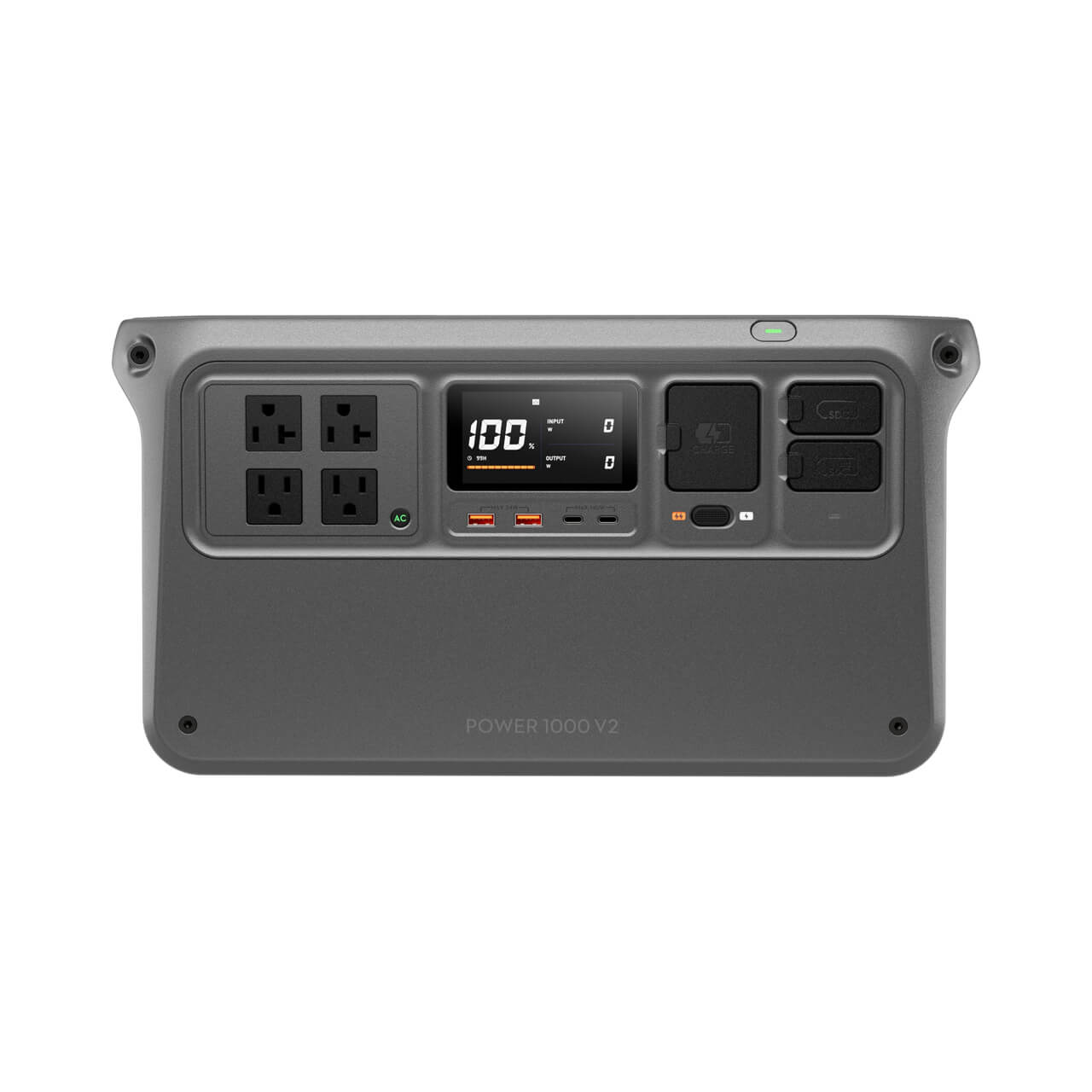
Physically, the Power 1000 V2 looks almost identical to the original, and we’d actually say that’s a really good thing. The design is clean, modern, and all of the ports are front-facing, with no awkward side or rear plugs. Even the handles feel solid, so the unit is easy to move, and the overall build quality feels exactly like what you’d expect from DJI.
Without expansion batteries, it weighs just over 30 pounds, making it a true portable power station and something that's easy to bring with you on the go. We also like that it has a low profile, making it easy to fit in tight spaces, like a shelf or the back of a car.
The display screen is another highlight. It’s bright, colorful, and extremely easy to read, even at a distance. Input rates, output power, and the remaining runtime are all clearly displayed without needing to dig through menus. The companion DJI app is pretty basic, but it lets you toggle ports, adjust a few settings, and monitor the unit remotely, which is handy.
One of the most welcome upgrades over the original Power 1000 is the move from two to four AC outlets. DJI also flipped their orientation, which sounds minor but actually makes a big difference. Larger plugs, like camera batteries, no longer block neighboring outlets. It’s basically the same outlet setup you get with the larger DJI Power 2000, which was released about a year after the original Power 1000.
We’ll go into more depth about this in the next section, but DJI also increased the AC input and made some changes when it comes to how you solar charge this power station. Spoiler: the solar input isn't just weird, it's pretty annoying.
Solar charging issue aside, we think these design decisions make this unit really practical for a lot of real-world setups.
Now that we know how this unit differs from the original version, let’s take a look at how it actually performs in the real world:
DJI significantly improved AC charging on the DJI 1000 V2. If you're charging from a wall outlet, you can now hit charge rates of around 1,500 watts, which means you can fully charge the unit’s battery much faster than the original.
Solar charging is where things get a little odd. You can technically push up to 1,200 watts of solar power into the Power 1000 V2, but only if you’re using DJI’s 1.8kW DJI Power Solar Panel Adaptor, which despite having 1.8kW in the name, only allows you to hit a solar input rate of 600W. with this power station. The remaining 600 watts are handled separately through a 12V style input. It works, but it’s not exactly intuitive, and it relies heavily on proprietary accessories.
That said, 1,200 watts of solar input means this unit can charge in under an hour in ideal conditions, which is genuinely impressive for a 1 kWh power station.
Expansion is another strong point for this power station. Adding just one DJI Power Expansion Battery 2000 nearly triples usable capacity, which makes the 2,600W inverter far more practical. DJI even includes a rolling cart with some bundles, allowing you to stack the battery and main unit and move everything around easily.
We were running the main unit alongside a single expnasion battery during most of our testing, and the pairing worked extremely well. While we didn't like that connecting an expansion battery takes up one of your two SDC ports, the battery paired instantly, and there wasn't any sort of communication issues between the power station and the expansion battery.
One area where the Power 1000 V2 really shines is UPS performance. The switchover time is extremely fast, making sure that sensitive electronics like computers never skipped a beat during our testing.
If you work on a computer all day, this is a legitimately useful feature. You could plug your setup into the Power 1000 V2, keep the unit connected to the wall, and you’re protected from outages without even thinking about it. A few commenters on our YouTube review even said they use it as a UPS for playing video games, so it could be the perfect option for hardcore gamers.
The efficiency also impressed us. In testing, the unit delivered 82% efficiency, which earns it an A-grade in our book. We measured a 76% efficiency rating when we tested the original Power 1000, so that’s a nice upgrade for the V2.
Idle consumption came in at around 18 watts, meaning the unit can sit powered on with devices connected for roughly two and a half days without actively running anything. That’s solid performance for light, intermittent loads, including stuff like a small fridge.
If there’s one thing DJI consistently nails, it’s having some of the quietest power stations on the market. Like the original, the Power 1000 V2 is incredibly quiet under normal use. You can get the fans to spin up if you’re pushing it hard for extended periods, but it’s practically silent most of the time.
This is what makes the unit so appealing for creatives (like ourselves). If you’re running lights, charging camera gear, or working in a filming environment, this is a power station you can leave on without ruining your audio. That alone makes it stand out from many competitors.
It also makes it a natural fit for people already flying a DJI drone, since charging batteries quickly and quietly is a huge plus on set or in the field. All of this makes sense when you consider the fact that the DJI brand gears most of their equipment towards creators, drone enthusiasts, and people who need to work in remote, off grid locations.
Before we take a look at the areas where we think this unit falls a little short, let’s take a moment to appreciate everything DJI got right with this refresh:
We mentioned it earlier, but adding another two 120V AC ports is a really welcome upgrade. If you’re going to be charging multiple camera batteries, running some studio gear, or even just keeping a few basic home appliances going during an outage, the four outlets are really going to come in handy.
We also like that all of these ports are on the unit's front panel, meaning you’re not going to be stretching to plug things in if you have it up against a wall or in the trunk of your vehicle.
We also love that this thing can be expanded to have over 11,000Wh of battery capacity. The expansion batteries also stack really nicely, and DJI will even throw in a hand cart if you purchase an expansion battery with this unit.
As mentioned before, we tested this power station alongside one of the expansion batteries. Not only did everything work extremely well, it was just a nice and clean setup. The hand cart makes pulling the unit and battery very easy, and everything is on the front, so it just works nicely.
It sounds like vague praise, but DJI gear tends to feel really premium. They didn’t reinvent the wheel with this updated version of the Power 1000, but that’s a good thing. It’s sleek, easy to use, the screen is intuitive, and it’s practically silent.
Nothing feels cheap or fragile, and it wouldn't look out of place in an office or studio. If you’re already a fan of DJI products, you’ll really enjoy adding one of these units to your setup.
DJI also bumped the output power up by giving this unit a 2,600W inverter. The old model had a 2,200W inverter, so you’re getting an extra 400W of output power. The internal battery remains the same, but now you can run heavier loads, like fridges, coffee makers, multiple studio lights, and more.
It turns this unit from a creator-focused power station into something that can actually handle some basic home backup applications. When you pair that 2,600W inverter with one or more expansion batteries, you’re getting a really practical setup from a brand that makes high-quality stuff.
No unit is perfect, and the Power 1000 V2 has a few pain points. Here’s what we didn’t like about this portable power station:
First, there’s still no built-in light. For a power station that would be a very practical option during outages, not having a light is a bit frustrating, especially given this is meant to correct the mistakes of the original. Even a small LED would go a long way when you’re plugging things in during a blackout.
The bigger issue is DJI’s reliance on SDC ports. The unit has two proprietary ports, which are what you use to connect expansion batteries, solar charging adapters, and 12V accessories. The problem is that you only get two of them. If both are occupied, say, one for the solar adapter and the other for an expansion battery, you lose access to other functionality like a 12V car socket. It works, but it’s not flexible.
It just seems really odd. Why not give this unit a separate expansion battery port and a dedicated solar input, instead of having your two SDC ports do pretty much everything? It’s weird and could be really annoying in real-world scenarios.
Cost is another factor with this unit. DJI’s solar and car charging adapter runs about $329, which stings when pretty much any other competing power station will include a solar input directly on the unit free of charge.
Speaking of overpriced accessories, DJI’s own solar panels are also extremely expensive. If you were to purchase a DJI 100W folding panel and the adapter you’d need to connect it to this unit, you’d be looking at close to $1,000! This is extremely difficult to justify when you can buy 400W bifacial rigid panels from retailers like Signature Solar for under $200 each.
The unit itself is great, but DJI has a tendency to charge really high prices for accessories and upgrades, even if some of those add-ons are pretty useful.
At the end of the day, the Power 1000 V2 feels like a meaningful upgrade over the original, and a good all-around unit. It’s built for creatives, filmmakers, and people already invested in DJI gear. If that’s you, this unit will feel familiar, polished, and extremely easy to use. It’s quiet, powerful, and has an all-around quality feel to it.
It would also work well for light home backup. Things like running a fridge, router, lights, or even a CPAP during an outage is well within its comfort zone, and the extremely quiet operation makes it suitable for bedrooms, small camper vans, or an RV.
If you want something expandable that can grow into a small home backup system over time, the Power 1000 V2 can do that too, but just be prepared for the accessory costs. Overall, we do recommend the DJI Power 1000 V2. It’s not the cheapest option, but it delivers where it counts.
On the other hand, if you’re someone who wants to really lean into the whole solar generator angle, you may want to choose something like the Pecron F3000LFP instead, as that would give you the same solar input, but without the need for an adapter.
We test solar products so you don’t have to. Check out our opinions and which units we think are worth your money and which ones aren't.
More Reviews >